


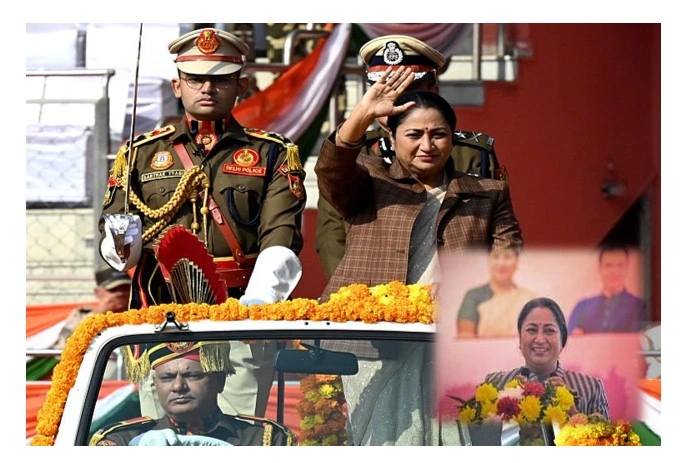
Delhi Chief Minister Rekha Gupta today hoisted the Tricolour at Chhatrasal Stadium on Sunday, January 25, 2026 in a grand ceremony that combined traditional pomp with an administrative agenda for progress. The ceremony is, beyond a ceremonial obligation, Gupta’s first Republic Day salute as Chief Executive of the National Capital Territory and marks an era change in Governance.
As the Chief Minister took the stage against a clear Delhi morning and reverberating sounds of marching contingents, she delivered her government’s 11-month “report card”. Her speech was more than the usual rhetoric of patriotism: She stewarded the spirit of the Constitution in bodily matters, including health, education and urban modernization.
The Maiden Salute: Reflections of the New Guard
The ceremony was marked by a solemn dignity when CM Rekha Gupta inspected the guard of honour and received salute by contingents. The parade had a well-disciplined march by Delhi Police, Delhi Fire Service, Home Guards and NCC cadets. For many in the stands, the day’s biggest crowd-pleaser was the marching-step tempo of the Delhi Police band, whose martial songs served as a stirring soundtrack to the morning’s maneuvers.
In her speech, Gupta emotionally remembered the framers of the Indian Republic and emphasised particularly the legacy of Dr. B.R. Ambedkar. The tricolour was theirs that fluttered above the stadium “after numerous sacrifices”, she said, alluding to the lyrics of Ae mere watan ke logon (People of my country) to bridge a yawning chasm between historical struggle and contemporary duty.
The constitution is not merely a legal document but the soul of India, said the Chief Minister. “For 77 years, it has been a lighthouse guiding the human race to a safe harbor of progress toward justice and equality and dignity for every person.”
11 Months In: A Report Card on Governing
Much of the event focused on detailing what the administration has achieved since being sworn into office in February 2025. Gupta outlined a number of core industries in what she called a departure from “administrative inertia”:
- Healthcare Revolution: Beyond Ayushman Bharat, On Ayushman Bharat health scheme, the Chief Minister said it was adopted in Delhi on the first day of formation of her government. And the results, a state report reads, were striking:
- Enrolment: More than 6.5 lakh residents have been enrolled under the scheme.
- Infrastructure: Over 300 Ayushman Arogya Mandirs (health centers) have been established in the city.
- Digital Inclusion:Govt hospitals have shifted to e-appointments so that there is no waiting or middle-men are involved any more.
Reimagining Education
Citing that education was receiving a share of 21% of the state budget, the Chief Minister focused on enforcement of Delhi School Education Act 2025. This law was aimed at restraining limitless rise in fee by private schools which must have come as a relief for parents. She also said there would be a ₹1,300 crore education hub in Narela which would emerge as a key centre for higher education and research.
Re-Imagining ‘Viksit Delhi’: The Path to 2047
Keeping an eye on the future CM Rekha Gupta also has dream to transform Karawal Nagar as per national intended Viksit Bharat @ 2047. Her manifesto for a “developed Delhi” prioritises sustainability, infrastructure and economic empowerment.
- Green Mobility and Transport: The Government plans to electrify all its public buses service 100% over the next three years. This includes bringing 11,000 new e-buses. The Delhi Metro network is also set to expand up to 500 km from the existing 396 km, making sure the city’s expansion doesn’t happen at the cost of its air.
- Economic Hub and Startup Policy: With the motive of making Delhi the strongest economic hub in the country, CM launched a startup policy. It could offer a glimpse of the potential gains from a future India-EU trade deal that opens up European markets to New Delhi’s thriving MSME sector, she said. “Delhi should be the hub of ideas,” she declared, citing a memorandum of understanding signed with the Reserve Bank of India to ensure developmental projects suffer no funding shortages.
- Safety and Social Welfare: Under the Safe City Project, 10,000 latest CCTVs are being installed along with one lakh smart LED street lights. Provisions for social security were also a focus area, with the formation of a Gig Worker Welfare Board and the scaling up of “Atal Canteens,” which today provide meals at ₹5 to 50,000 people daily.
Cultural Vibrancy and the Soul of New Delhi
India’s cultural diversity was showcased in a colourful manner at the end of the Chhatrasal Stadium ceremony. As many as 9,000 students from Delhi’s schools presented folk dances and aerobic displays enacting the “unity in diversity” that the Republic signifies. The Chief Minister also paid respects to personnel from Delhi Police and Fire Service with medals for exceptional bravery, saying the republic is protected on a day-to-day basis by “unsung heroes”.
As the event ended, there was a sense of calm determination. In her maiden Republic day address, CM Rekha Gupta seamlessly connected the ceremonial heft of the office with a pragmatic, outcome-driven style of governance. In delivering such a transparent report card at such an august gathering, she set a standard of accountability many hope her term would be marked by.
Shamiana tented-box enclosure at the Chhatrasal Stadium is a reminder that while the national parade astride Kartavya Path shows up India’s military hardware, it is nonetheless on state stage that the republic’s promises to health, education and dignity are actually delivered to those Indians.
