


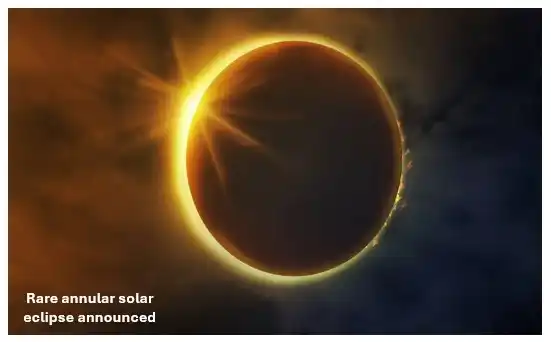
An annular solar eclipse, also called as a ring of fire will take place on Tuesday, February 17, 2026. This occurs when the Moon passes in between the Earth and the sun, but is not quite able to eat the entire disk of the sun leaving behind a glowing ring of sun light all around the outline of the Moon.
Where will it be seen?
The annular phase or, ring of fire will be seen primarily over parts of Antarctica and the surrounding Southern Ocean and has virtually no permanent human presence.
Outside of the very narrow path:
A partial eclipse might be seen in the Southern Hemisphere including some parts of southern Africa and the southern end of South America and several nearby islands.
India and most of Asia, Europe and North America will not be able to see the eclipse.
Timing and Duration
In UTC:
- Beginning of the partial eclipse – 09:56 UTC
- Maximum phase – 12:12 UTC
- End of the partial eclipse – 14:27 UTC
For India in IST, the eclipse occurs late afternoon to early evening, but due to its location in the world and the lack of a direct view, it will not be seen.
The annular phase, ring of fire, will last a very short time, about two minutes from the very center of the path.
Why It’s Special?
Although annular eclipses are correlation of annular eclipse and solar relation did not correlate. An annular eclipse occurs when the Moon is near its point of apogee. Thus, it will not completely cover the Sun.
This is a significant event because of its nearly exclusive route through very remote, inaccessible locations (most will never see this eclipse) and likely to be seen only by scientists or individuals observing in proximity.
Safety and viewing
Solar eclipses should not be observed with the naked eye (this applies even to partial phases) unless you have special eclipse glasses or filters. Intense sunlight may cause irreparable damage to your eyes.
The use of live streams and television machines by astronomical organisations, or from space will provide the best access to this event for those who cannot get there safely.
What does this mean for India?
India will not see this eclipse after the night of sun eclipse (not). Thus, any Hindu religious observations occurring during solar eclipses (such as Sutak Kaal) are likely to be inappropriate due to this new event.
