


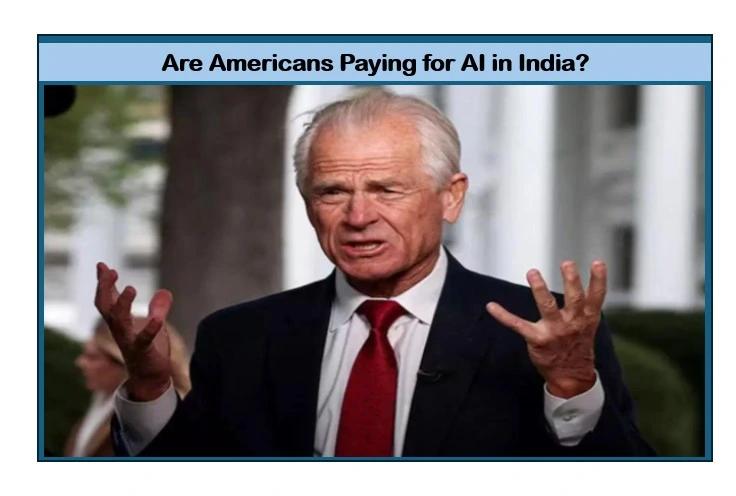
Peter Navarro, the trade specialist for the White House, has said something controversial about India again. This time, he asked why the facilities and energy that power the artificial intelligence (AI) services that Indian users use are based in the United States. There are trade issues between the two countries that are still going on, including differences over taxes, energy policy and the fact that talks on a mutual trade deal have been put on hold.
Navarro questioned the reasoning behind American-made AI platforms, like ChatGPT, having a lot of users from other countries while still being based in the US and using American energy. He said this during an interview on the Real America Voice show. He made the case that it was in the national economic interest, which started a new conversation about trade policy and global technology services.
Navarro’s Point of View on AI and Electricity
Navarro said that the best AI systems, which are built and housed in the US, are essentially subsidized by US infrastructure even though they serve people in India and China. He said this makes me wonder if American taxes are indirectly paying for services that are used a lot in other countries. Navarro says that the fast growth of AI data centers might be raising the demand for power, which could affect how much people pay for their home energy.
It’s like, why are Americans paying for AI in India? he asked during the show, stressing that platforms based in the US and using American power serve a lot of people from other countries, which is something that should be thought about more in policymaking. Navarro said that the Trump administration might take strong action in the future to deal with worries about how AI data centers affect the energy grid and prices in the United States.
US Lawmakers Push to End Trump-Era Tariffs on India- A Shift in Trade Relations
There is a bigger trade dispute and Maharaja Tariffs
The things Navarro said are part of a larger trend of trade problems between the US and India. The Trump administration has put high tariffs up to 50% on many Indian imports in the past, saying that India’s continued sales of Russian crude oil and larger trade deficits were to blame. Navarro has said many times that India’s high tariff barriers are bad, and he has even called the country the Maharaja of tariffs.
He has also said bad things about India’s energy plans, such as the fact that it buys cheap oil from Russia. Navarro and other US officials have said that these purchases add to the pressures in global politics. However, Indian officials have strongly denied this, saying that their energy choices are based on market conditions and strategic needs.
The AI words are similar to what Navarro said about trade before, and they show that economic diplomacy between Washington and New Delhi is getting tough. People in the business world have pointed out that his comments on technology and energy are different from what is usually said in trade disputes. This shows how digital services and infrastructure are becoming more important in 21st-century trade disputes.
Could raise tariffs on India’: Trump’s fresh warning over Russian oil trade
Responses and a Bigger Picture
People all over the world have criticized and thought about Navarro’s statements. Some experts say that the way he frames the issue oversimplifies how AI services are paid for and used around the world. They point out that tech companies like OpenAI and others invest in infrastructure for profit, not as a way to get money from the government. Critics also say that using data services and services across countries is a normal part of the global digital economy. This is because services are bought and paid for through subscriptions or usage fees, not by where the computers are located.
People in India saw the comments as more conservative talk that doesn’t take into account how global technology progress and digital markets are. Indian leaders have always stood firm on their views on trade policy and buying energy, citing sovereignty, economic security, and military authority as important issues.
Trade talks between the two countries are still going on, covering everything from taxes to bigger trade deals. Navarro’s new words are likely to make things even more complicated in a relationship that is already very tense. Observers say the debate shows how hard it is to balance political forces in the US with the facts of a global economy driven by digital services that are linked and complex.
