


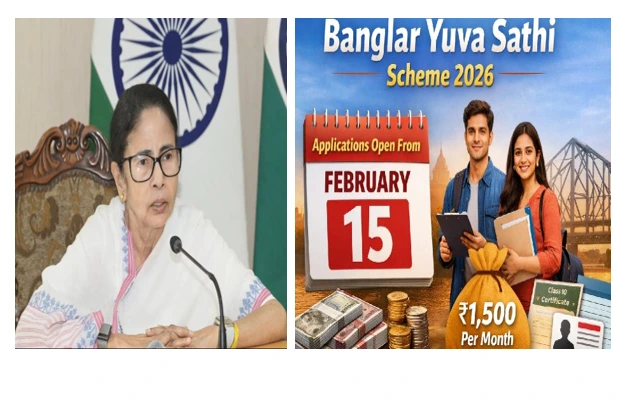
On Tuesday, West Bengal Chief Minister Mamata Banerjee introduced an additional source of income for educated, unemployed people in the state that will provide each eligible person with ₹1,500. The Banglar Yuva Sathi/Yuvasathi Unemployment Allowance Programme is not only a significant new initiative from the West Bengal Government as part of their plan to support youth but also a significant move in advance of the upcoming Assembly elections in 2026. According to the original plan, the launch date was set for 15 August 2026; however, at Tuesday’s press conference at Nabanna (the State Secretariat), Mamata Banerjee announced that the scheme’s rollout will be earlier than originally planned. CM Banerjee stated that it was essential to provide immediate assistance to young jobseekers and to help establish her government’s viability for elections in the coming year.
Eligibility Criteria
To qualify for this scheme, youth must meet the following criteria:
- Aged between 21 and 40 years old (must be between 21 and 39 on the date of the application for assistance)
- Have successfully completed the Madhyamik Examination (Class 10) or its equivalent
- Reside in West Bengal
- Qualified youth will receive an income of ₹1,500 per month until their employment or a maximum of five years, whichever comes first.
- Individuals who are benefitting from other governmental assistance programs (excluding scholarships and educational benefits) will not be able to apply for this benefit.
The State Government has put together an assembly constituency registration programme to allow participants to register. These registration camps will take place between February 15, 2026, and February 26, 2026.
At these camps, people can fill out an application form and provide any additional information needed. At this time, there are no online forms available; however, a sample application form can be found in the Department of Sports and Youth Affairs.
Applicants must also provide identification including proof of employment, Social Security Number, bank record, Cabinet Supervisor’s letter and a two-inch photograph.
The timing of the announcement is significant as the State of West Bengal approaches Assembly elections. The plan for introducing this new program prior to the elections is being viewed as a deliberate attempt by the government to win over young voters through providing financial support.
Political commentators believe that Chief Minister Banerjee has developed an income support system as part of her broader approach to governance, and that helping to build up political support in advance of elections is the primary objective. However, some observers have also commented on how such income support schemes may ultimately have longer-term consequences with regard to costs of government and unemployment.
Implementation and Coverage Goals
Although statistics regarding the number of recipients of Yuva Sathi and the cost of the program will not be released by the state government until a future date, current data from the government’s budget documents and other financial reports show that the Yuva Sathi program will potentially be one of the state’s largest and ongoing costs.
State officials have also noted that recipients of Yuva Sathi will still be able to access other forms of educational scholarship support while continuing to receive their payments through Yuva Sathi, as long as there is no overlap between the scholarships provided through Yuva Sathi and other welfare programs that provide scholarship funds with different eligibility criteria.
Mamata Banerjee says that AI deleted 54 lakh names from the Bengal voter list
What Supporters and Critics Are Saying?
Critics argue that targeted income assistance programs will not sufficiently address systemic employment challenges, and could create financial burdens for states if expanded to include many groups within the population. Additionally, those in opposition to such funding questions how these programs are aligned politically by being implemented just before an election, and whether or not they are worthy of further priority or long-term development planning.
Moving Forward
Both the application process and program startups for Banglar Yuva Sathi have begun. As of now, many people in West Bengal are already talking about how this program will impact unemployment, youth livelihoods and the electoral environment. Effectively, much of our future will depend on how these factors cause change in the months to come.
