


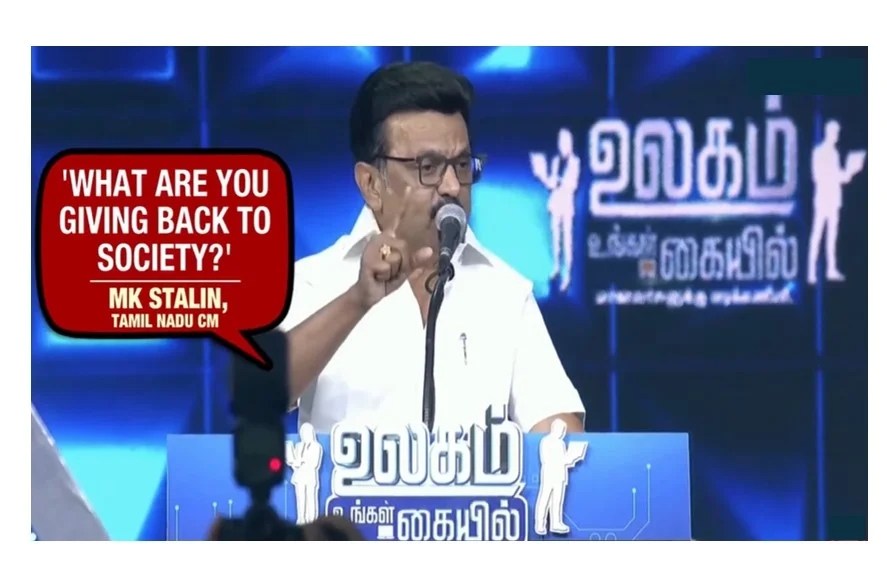
In a watershed moment for digital inclusivity, Tamil Nadu Chief Minister M.K. Stalin formally inaugurated long-awaited “Ulagam Ungal Kaiyil” (The World in Your Hands) scheme on Monday – 5th January 2026. In a grand function at the Chennai Trade Centre, bose Vandalur and distributed free laptops to students of his College.A new dawn has begun in the lives of Tamil Nadu youth.
Speaking before a full meeting hall of students and teachers Stalin stressed that these devices are not “freebies.”
A Smart Bet on the Future
The ‘Ulagam Ungal Kaiyil’ project is one of the most ambitious digital literacy initiatives in India. Instead of thinking of it as a populist handout, the state government has started to spin the policy as a smart investment in human capital.
- Overall Target: The programme plans to distribute twenty lakh laptops in two years time.
- Launch of First Phase: 10 lakh laptops are to be provided to the students in the entire state during current phase 2025-26.
- Budget: Astonishingly, for this first phase alone, the government has set aside a budget of ₹2,000 crore.
Addressing a gathering at the launch of the same, Chief Minister said “For us, this is not an expenditure but is an ‘investment’ for the education of future generation. Study hard and make a good way to rule the world.”
AI Era High-Performance Hardware
Unlike to previous editions of such schemes, heavy focus has been given in the 2026 laptop distribution on high-end specifications to ensure that students can cope with today’s complex software, coding environment and AI tools. The government has joined with international giants Dell, Acer and HP to deliver reliable hardware.
Key Specifications:
- Processsor: Runs on Intel Chips, i3 or AMD chips or Ryzen 3.
- Rapid Performance: Features 8GB DDR4 RAM and a 256GB PCIe SSD for ultra-fast boot speeds and efficient data handling.
- Dual boot OS- Pre-loaded Windows 11 Home and BOSS Linux providing enhanced support to both teaching and learning requirements.
- Suite Software: Features MS Office 365 and in an unprecedented step, also includes six months free access to Perplexity Pro, a cutting-edge AI research platform.
From the addition of AI platform subscriptions we can see that this government means business: It’s not about teaching basic computer literacy, but rather high-tech skill development across software engineering and data analytics to digital marketing.
Who is Eligible?
The scheme would be all-inclusive and would address students from different academic backgrounds studying in government and government-aided institutions.
Eligible streams include:
- Course wise list of professional courses: Medical (MBBS), Engineering (BE/BTech) and Law.
- Polytechnic colleges and Industrial Training Institutes (ITIs) are also involved in technical education.
- These colleges come under General Higher Education, Arts and Science /Oriental /Legal/Teacher Training and Education /Engineering Colleges.
At the top of that list: narrowing the “digital divide” separating rural and urban students. Equipping students of economically weaker society with latest technology would bridge the digital divide and that one’s economic condition must not be a hindrance in acquiring quality education and training to compete at global job market.
Zoho CEO Sridhar Vembu wants India to hire people based on their skills instead of college
Bridging the Skills Gap
Using the platform, Chief Minister Stalin urged the students to go beyond entertainment.
This project is closely associated with the Naan Mudhalvan (I am the First) scheme. Owning these devices allow students to access online certification courses, freelance on global platforms and even prepare for competitive exams from the comfort of their homes instead of visiting costly coaching centres or cyber cafes.
The government predicts this will result in:
- Greater Employability: You will leave with experience of using important software.
- Socio-Economic Development: Empowering the rural Tamil Nadu society in a digital economy.
- Workforce of the Future: Preparing students for an AI-integrated economy.
Conclusion: Vision For Tamil Nadu Digital
Revival and expansion of the laptop scheme is cue enough to one hoping that the late former CM M. Karunidhi’s dream, when he unfurled the state’s fi rst IT policy 25 years ago, will unapologetically extend across TN. By “placing the world in the hands” of 20 lakh students, who study in minority-language schools, The current DMK government is staking on harnessing the intellectual capital of its youth to propel another round of economic growth in the state.
But as distribution centres in districts start giving out these devices this week, the message from Chennai is unambiguous: Tamil Nadu is poised to lead the AI revolution –– one student at a time.
