


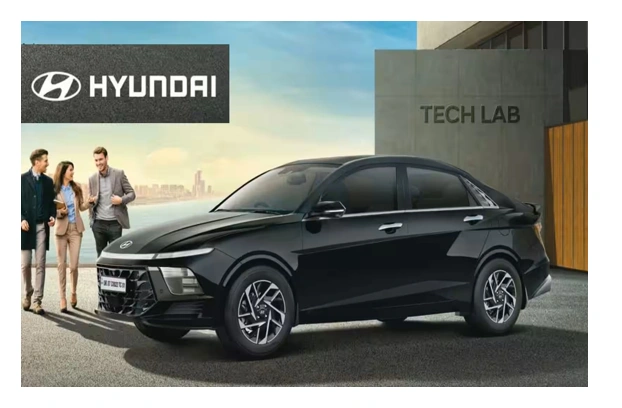
The Indian motor industry has a history of having affair with sedan and the name of the Verna has a huge weight in it. Hyundai motor India revived this segment on March 9, 2026, by unveiling the wraps on the 2026 Hyundai Verna facelift. The new Verna has a starting price of Rs 10.98 lakh (ex-showroom) and it is not merely a mid-cycle update, but the statement that will help Hyundai regain the throne against the competitors such as the Volkswagen Virtus and the Skoda Slavia.
During a period when SUVs are taking over the newscast, the Verna facelift triples the virtues of a sedan, namely, a low-slung profile, high-velocity stability, and an interior that feels like a technology-saturated sanctuary.
A New Face: Hard-cut, Chiseled, and Commanding
The Verna 2026 does not hesitate to attract attention. The design language used, the “Parametric Dynamics”, is retained but the facelift is all about making the front fascia more commanding. The most noticeable of the changes is the new black-chrome radiator grille that makes the car look very sophisticated and aggressive at the same time. It is surrounded by revamped dual LED projector headlights which are lower in an even more muscular front bumper.
Read also: Volkswagen India Plans Five New Car Launches in 2026
The Cockpit of the driver: Both Tech and Comfort
Entering the new Verna is like crossing a generational divide. It has evidently shifted the focus to the creation of a more luxurious and technologically progressive cabin. The feature added is the dual integrated 10.25-inch displays- an integrated curvilinear system that accommodates the high definition infotainment as well as the digital instrument cluster. It is, rather simply, the finest screen property in its category.
However, it is not the screens themselves. Hyundai has targeted the human aspect of the drive:
- Segment-First Powered Passenger Seat: This now equips the driver and the front passenger with electrically adjustable seats.
- The Welcome Retract Feature: To facilitate access and exit, the driver seat slides back automatically when the door is opened, which is a luxury car features typically tend to have twice the price.
- The “Boss Mode: As a person who likes to be chauffeured, a special switch enables the rear passenger to move the front co-driver seat and gives the feeling of a lot of room at the press of a button.
The inside is clothed in high quality leatherette upholstery and the new D-cut steering wheel bears the Morse code H logo of the brand, a slight reference to the Hyundai Ioniq range of the future.
Read also: 2026 Lexus ES India Launch March 20th – Swanky Design, Hybrid
Power and Performance: the Turbo Legacy Lives on
Hyundai has been mechanical and has remained true to its winning formula where it offers either efficiency or pure and unadulterated power.
- The 1.5L MPi Petrol: With 115 PS and 144 Nm, it is the engine that the urban commuter will prefer due to its smoothness and reliability. It is either mated with a 6-speed manual or IVT (CVT) automatic.
- The 1.5L Turbo GDi Petrol: The center of the passion of enthusiast of Verna. With a class leading 160 PS and 253 Nm, this engine makes the sedan a highway weapon. It will either have a 6-speed manual, or a 7-speed Dual Clutch Transmission (DCT) that is lightning-fast.
The Verna has chosen driving modes, Eco, Normal, and Sport, in the automatic models with paddle shifters; meaning the driver can determine how the ride would be.
Read also: Indian Women in Sarees Inspired Hyundai’s Tall Hatch Design
Not an Option, Safety as a Standard
As a step that will mark a new standard in the segment, the top-spec variants of Verna now come with 7 airbags as standard. The safety package is far more in-depth though. The Hyundai SmartSense Level 2 ADAS is revised and now has 20 features on board with:
- Forward Collision Warning and Avoidance.
- Lane keeping Assist and Departure Warning.
- Blind Spot View Monitor (displays on the instrument cluster itself).
- 360-Degree Camera: It will replace the reverse camera that was used in the past and is difficult to use when there is lack of parking space.
Moreover, an integrated dashcam is an excellent feature that was introduced after the factory model, which shows that the Indian car owners are increasingly interested in security and the ability to record evidence.
