


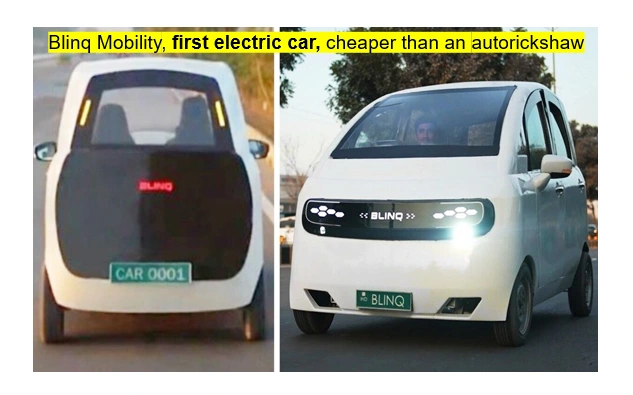
A silent revolution is occurring in the congested streets of Gurugram one that will resemble a futuristic Tata Nano but will be resembling the future of urban transport in India. Blinq Mobility, a startup based in Gurugram and founded by IIT Delhi graduates and former colleagues at Tesla has taken the first step on the road with their first prototype of an electric car, which is now called car1 (previously referred to as the Pod).
It is not only the technology that the headline has made headlines in the country; it is the price. Blinq plans to sell this micro-EV at an equivalent price of a three-wheeled autorickshaw that might make it the cheapest four-wheeler in India.
Our “Autorickshaw” Price Point: Breaking the Entry-Level
The Indian middle-class has been searching years to find an aspirational link between the humble scooter and the expensive sedan. Whereas the Tata Nano had previously tried to occupy this niche, Blinq Mobility is now completing the task with the EV revolution.
This will enable Blinq to maintain an initial sticker price of 3.5 to 4 lakh by not charging the vehicle and battery cost together, with a subscription model. This contributes to the fact that it is substantially cheaper than the MG Comet EV or the Tata Tiago EV, making it a direct competitor to the ubiquitous autorickshaw to be used in an urban fleet and in personal use.
Blinq Mobility Founder and CEO, Nikesh Bisht, says that its vision is to offer 4-wheeler experience with its safety and comfort at a 3-wheeler price.
Read also: Diesel Cars Still Available In India In 2026- 10 Models
Technical Edge: Tesla DNA in a Shell of an Indian
The team of leadership at the startup has high-speed experience. Ankit Kumar, a former Tesla engineer (Cybertruck and Robotaxi programs) who has headed the design, is designed to be built-to-order around the desires of high-utilization urban spaces.
Commuting with Human grace: Safety and Dignity
The shift to micro-EVs such as the Blinq Car1 is more a matter of social mobility than a matter of transport. An autorickshaw is a survival weapon to millions of gig workers and small scale entrepreneurs and it may provide little protection against the weather or road accidents.
The Blinq EV is provided with an enclosed, air-conditioned cabin, which features some dignity and safety, which the three-wheelers cannot compete. To the Lakhpati Didis and the rural entrepreneurs that are cropping up in India, a car that will cost them as much as a rickshaw but will do the job of a car is a game-changer.
Read also: 2026 Lexus ES India Launch March 20th – Swanky Design, Hybrid
The Road to Launch: Pilot Programs in 2026
Blinq has acquired 4.3 crore in pre-seed funding (led by 8i Ventures and IIMA Ventures) in late 2025, and now it is in the real-world validation stage. The initial six months of 2026 will be spent in smoothing out the kinks that are found during the road testing in the Delhi-NCR region.
The startup is currently:
- Homologation: The Application to the Automotive Research Association of India (ARAI).
- Infrastructure Construction: The installation of its own first autonomous battery-swapping stations.
- Introducing Pilots: Intended to launch a small fleet of commercial ride-hailers by mid-2026.
