


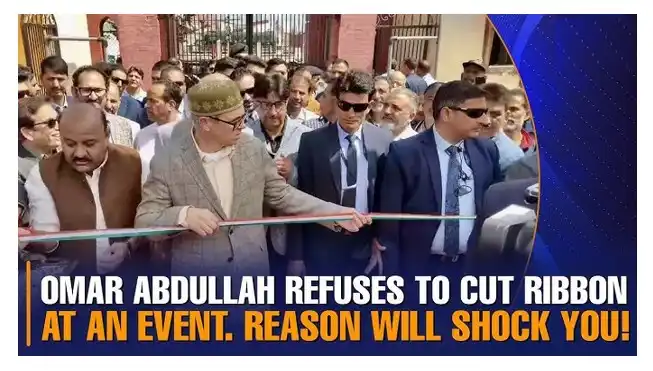
After being criticized as a violation of protocol for not cutting a ribbon while attending a public event in Jammu and Kashmir, Omar Abdullah (who is the Chief Minister) was immediately thrust into the media spotlight and raised eyebrows across the nation. Some critics believe that there is a valid reason for Abdullah’s refusal to cut a national tricolor ribbon and interpreted it as an affront to the Indian flag, while others feel that there is no reason he should have declined to cut a ribbon which is supposed to represent the national flag.
A Political Statement Sparks Debate: Background of the Incident
The use of the ribbon as part of the inaugural ceremony was routine; however, it has become a political decision by Abdullah as well as many other people across the country. In fact, there has already been considerable discussion regarding the underlying reasons for Abdullah’s refusal to cut a ribbon meant to represent the Indian flag. It can be classified as both a matter of national protocol as well as possibly being interpreted as a form of political statement.
also read: PM Modi and Kharge pose at Ambedkar Jayanti event
Omar Abdullah’s Explanation
In an effort to clarify his reasoning for not cutting the tricolor ribbon during the inauguration ceremony, Abdullah explained that the Indian Tricolor should be treated with respect. He indicated that a ribbon representing the flag should not be used simply to cut or as an item used to decorate an indoor area. Based on these two points, Abdullah explained that a decision to cut the tricolor ribbon would be an affront to the Indian flag and therefore would be inappropriate because it would send a message that the Indian flag is insignificant. Abdullah also emphasized that he was not making any type of political statement by declining to cut a ribbon that is supposed to represent the Indian flag, but rather was simply respecting the Indian flag as a national symbol.
also read: Do parties have the authority to remove their Rajya Sabha MPs?
Legal and Ethical Dimensions
The incident has shone a light on the larger legal and ethical issues related to the Indian flag. The Flag Code of India outlines the proper way to hang and care for the tricolor. The code does not expressly talk about the use of the flag for ribbon cutting, but it does indicate that the flag should not be used in a way that would detract from its dignity.
Abdullah’s supporters argue that his position aligns with these values. They think that turning the tricolor into a ceremonial ribbon and cutting it may violate the spirit of the guidelines.
also read: Pakistan threatens to hit Kolkata during future conflicts
Political Response
The response from political parties has been very different. Some opposition leaders have criticized Abdullah, claiming that his refusal was unnecessary and could be seen as politically motivated. They claim that the tricolor has been used in many different ways at public events, without any problems.
In contrast, Abdullah’s party members and a number of neutral observers support his decision. They believe that Abdullah’s action demonstrates a greater respect for national symbols and sets an example of how to preserve their sanctity.
Public Opinion and Social Media Debate
The number of people commenting about this issue on social media is great and, as you may guess; the opinions are very split on Abdullah’s action to stand up for what he believes to be a moral principle. His act has been interpreted as a great example of the need to protect national symbols. Other people feel that the gesture was an act of excessive caution or nothing more than a political statement.
The use and popularity of hashtags have been exploding since the story broke, with many people expressing their viewpoints regarding whether gestures such as these actually mean anything, or if they only show off for others.
Broader Implications
Several larger issues have arisen from this incident. First and foremost, this situation leads to questioning how national symbols are presented and represented in the daily life of citizens and ultimately creates tension between those who honor displays of patriotism and those who have a perception of disrespect toward the tricolor.
Second, the ceremony’s symbolic meaning can create ambiguity with respect to the use of the tricolour emblem by public officials, particularly at the highest levels of government. Abdullah’s refusal to wear the tricolour as part of the ribbon-cutting ceremony may influence how similar ceremonies are structured in the future and how carefully the tricolour should be used in public.
Bottom line:
Overall, Abdullah’s decision to not wear the tricolour has served as a reminder that ceremonial acts can spark a discussion and ongoing debate regarding the significance of the tricolour when used as a symbol of nationalism; whether it was indeed used by him to make a political statement; and that it is the responsibility of all representatives of the tricolour to properly display it.
