


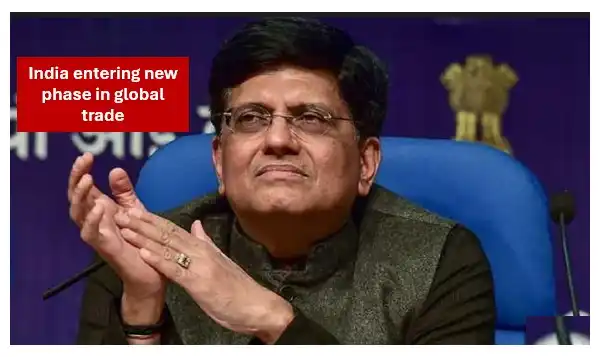
Union Minister Piyush Goyal did not merely speak in the quiet murmur of the Lok Sabha ; he created a picture of a country finally coming out of its shell of defense. The country is at a new stage of global trade, he said and his voice was full of the significance of recent landmark negotiations, which have altered the economic seriousness of interest of the country fundamental.
India has been perceived as the “varying negotiator” for decades, which is a nation that is more worried about defending its boundaries than opening its markets. However, nowadays, the story has ended up being the opposite. Even in the echelons of high politics in Brussels, and in the resurgent trade talks in Washington, India is no longer content to be seeking a seat at the table; it is now increasingly becoming the table itself.
The Dawn of the “Mega-Deal” Era
The key of this new stage is a set of trade agreements, which are not only record deals but also come to fruition at the beginning of 2026. Only weeks earlier, India has struck what people are referring to as the Mother of All Deals the long awaited Free Trade Agreement (FTA) with the European Union. The accord has opened up a market of close to two billion to the Indian businesses after almost two decades of impasse on responsiveness over responsibilities in all issues, including Scotch whisky down to the dairy industry.
Within this agreement, instant duty abolishment has been implemented on more than 90 percent of the export value in India. This is significant to the weaver in Varanasi or the footwear producer in Agra since the products would finally face their competitors in Vietnam and Bangladesh on an equal footing.
At the same time the so-called Father of All Deals, a historic reset with the United States, has reduced reciprocal rates on Indian commodities 25 per cent down to 18. This is a strategic move as it provides the Indian exporters with a differentiated price in the most profitable consumer market in the world. Although the price came at a major change in the energy policy, not switching to Russian oil and Western sources, the point was made: India is ready to make radical decisions to ensure its long-term economic presence.
you may also like:
- Global Media Highlights India-US Trade Deal
- Trade unions calling a strike on Feb 12 2026
- India Caps US DDGS Duty Relief at 5 Lakh
- Sensex jumps 4200 points after India-US trade deal
Avoiding Instability in the Global Environment
The most dramatic aspect of the announcement made by Goyal is the timing. With the conflict in West Asian flickering and supply chains across the Strait of Hormuz having their way once in a while, the trade figures of India have been astonishingly solid.
Though the export of merchandise remains almost flat up to February, it has not fallen down, which is an achievement in itself in the context of the world environment. Essentials are good, Goyal stressed, as indicated by a services sector that is still ever-increasing month-on-month.
This toughness does not happen by chance. It is the product of a so-called tiers-based industrial policy under which India is strategically open in areas where it is gaining strength and self-reliant in fierce ways where it feels vulnerable. The nation has diversified its energy suppliers to a total of 40 countries and accumulated a foreign exchange that can meet the imports of almost one year.
Beyond the Numbers: Making the Trade Shift Human
Behind this miraculous number of cumulative exports of $720` billion dollars, there is a story behind. It is a narrative of the 2.5 million jobs generated in the electronics production in the past decade. It concerns the Indian specialists, architects, nurses, and IT specialists whose ways to work in Europe and the UK were now smoother in accordance with new mobility clauses.
The vision of 2026 by Goyal is based on the assumption that trade should be helpful to the many and not to the few. The new FTAs have been formulated with a keen interest of safeguarding sensitive sectors. An example is the dairy industry that are still safeguarded as also the interest of millions of Indian farmers and fishermen is guarded by keeping off the genetically modified (GM) products.
