


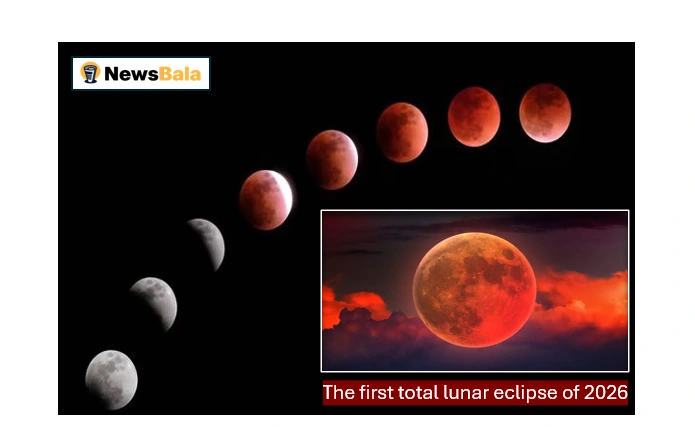
Today, India will see the first total lunar eclipse of 2026. It will be a rare and beautiful sight in the night sky. Public and science fans alike are interested in the event because the Moon will fully disappear into Earth’s shadow, making what is often called a blood moon glow. The India Meteorological Department has also shared new information about when and where in the country people can see the eclipse.
What Makes a Total Lunar Eclipse Happen?
When the Earth is right between the Sun and the Moon, there is a total lunar eclipse. The Earth stops the Moon’s sunshine, so its shadow covers the whole surface of the Moon. The Moon doesn’t get totally dark; instead, it looks red. This is because sunlight that passes through Earth’s atmosphere is blocked, allowing red light to reach the Moon.
When these stars line up, one of the most beautiful cosmic events that can be seen with the human eye happens. A lunar eclipse is safer to watch than a solar eclipse because you don’t need any safety gear.
When and how an eclipse happens
The information given says that the eclipse will start in the afternoon with the penumbral phase, when the Moon begins to move into Earth’s outer shadow. This stage is usually mild and may be hard to spot. The next phase is the partial phase, during which part of the Moon becomes dark as it enters a deeper shadow.
Totality, the phase when the whole Moon is covered by Earth’s umbra, is the most anticipated one. The Moon will turn a coppery or red colour during this time. Viewers will have a good chance to see the event since the eclipse will last until the evening.
The Moon will rise in many parts of India while the eclipse is still ongoing. This means that some people might miss the early parts, but based on where they are, they might still see some or all of the phase.
Read also: Holika Dahan 2026 on March 2 or 3?
Viewability All Over India
Most of India will be able to see the eclipse, though the experience may vary slightly in some places. People in the Andaman and Nicobar Islands and other eastern and northeastern parts of the country are expected to see the total phase more clearly.
In some places, the Moon may rise after the eclipse has started, so people can see it partly covered or shining red. The weather will also be very important in figuring out how well the event can be seen. The best viewing will be when the sky is clear.
The total lunar eclipse will be seen from many places around the world, making it a very popular astronomy event.
An interesting coincidence with Holi
People are paying more attention to this year’s total lunar eclipse because it happens at the same time as Holi. The fact that a big fair and a big astronomical event happen at the same time makes the day even more special. There are no safety precautions needed to see a lunar eclipse, but some people may follow old traditions associated with eclipses.
People interested in both science and cultural practices at these kinds of events are curious about the time. From a scientific point of view, it is still a natural event in space caused by the regular motion of orbits.
Read also: Rare annular solar eclipse
How can you watch it
One of the safest and easiest things to see in space is a total lunar eclipse. You don’t need telescopes or any other special gear, but glasses can help you see better. It’s enough to just go outside in the evening and look up at the eastern sky to see something amazing.
Seeing the Moon’s golden glow during totality is a special treat that doesn’t happen very often.
