


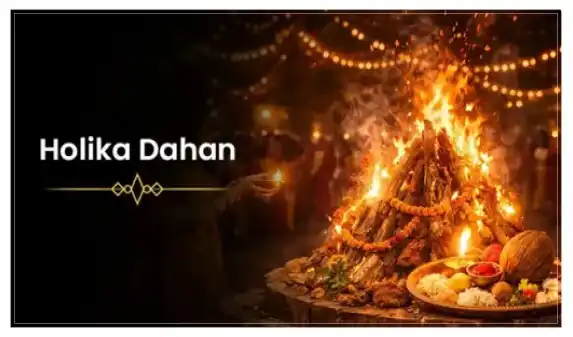
The winter cold is starting to lift and the smell of dry soil and spring flowers gives the opportunity to Indian people to be ready to the most colorful change. In 2026 however, the coming of Holi has come with it a spirit of heavenly wonder. You are not the only one who has been glancing at the calendar twice and could not decide when to burn the sacred bonfire on March 2 or on March 3.
The misunderstanding is brought about by a rare coordination of the lunar cycle, the Bhadra period and a lunar eclipse. The way to get through this holy period is to not follow the Gregorian date but to go into the heart of the Panchang.
The Great Date Debate: March 2 or March 3?
Hindus have all festivals governed by the Tithi (lunar day). In the case of Holika Dahan, the ceremony needs to occur during Phalguna Purnima (full moon night). The Purnima Tithi starts on Monday, March 2 at 5:55 pm and ends on Tuesday, March 3 at 5:07 pm.
Although the full moon actually begins on the evening of March 2, it is accompanied by Bhadra Kaal, a season traditionally viewed as something inauspicious to do any significant rites. It has divided the astrologers and scholars: some say that the late-night ritual on March 2 was intended to evade Bhadra; others to the evening of March 3.
read also: Holi 2026 Meets Chandra Grahan
Shubh Muhurat: The Time to Light the Fire
It is all about timing in regards to Holika Dahan. The time of lighting the fire is thought to derive the full protective power of Lord Vishnu.
- Holika Dahan Date Tuesday, March 3, 2026
- Main Puja Muhurat: 6:22 PM to 8:50 PM
- Hours of Operation: 2 Hours 28 Minutes.
- Lunar eclipse (Chandra Grahan): March 3 (end till 6:46 PM)
Due to the lunar eclipse on the same day, most of the priests would recommend the puja and setting up the bonfire as soon as the eclipse is over and the period of the Sutak (purification) is over and its time coincides with the evening Muhurat.
read also: 3rd March 2026 Dol Purnima
Rituals of the Night
During the Parikrama (circumambulation), family members come together in order to do so. Conventionally one offers:
- New Harvest: Giving thanks to the earth with ears of wheat and gram.
- Coconuts and Sweets: It refers to the sweetness that we want to introduce to the new season.
- Sacred Ash: The ashes are taken home the next morning by many people they put a small mark on the forehead of the person as a form of protection and health.
read also: Observing Papmochani Ekadashi and Meena Sankranti
Salutations to Be with Loved ones
In the internet era, the coziness of the fire blaze passes through our screens before we even get to see each other face-to-face. In case you need the correct words to write to your family and friends this year, the following are some of the emotional messages:
- For Spiritual Growth: May the flame of Holika Dahan shine all the dark corners of your life out and leave behind the light of happy-days and wealth. May you get a peaceful night and a morning of bright colors!
- For Strength and Devotion: Similar to Prahlad, are you sufficiently dependable and faithful and are your goodness and compassion your source of power. May the lucky fire of 2026 shine a new day to your house. Happy Holika Dahan!”
- A Short & Sweet Note: Lighten the load with your Holika fire and be smiling at the spring. wishing you and your family a Happy Chhoti holi!
Thinking Forward: The Festival of Colors
Just after the bonfire, on the morning of Wednesday, March 4, 2026, will be Rangwali Holi (Dhulandi). At this point, the seriousness of the fire is replaced by the disorder of colors.
When the smoke of the pyre of Holika has settled it has left a plain sheet on which the Gulal (colored powder) takes over. You celebrate on the 2 nd or the 3 rd, according to the local custom, but the spirit is that truth prevails, spring comes, and love, at any rate, puts its color in everything.
