


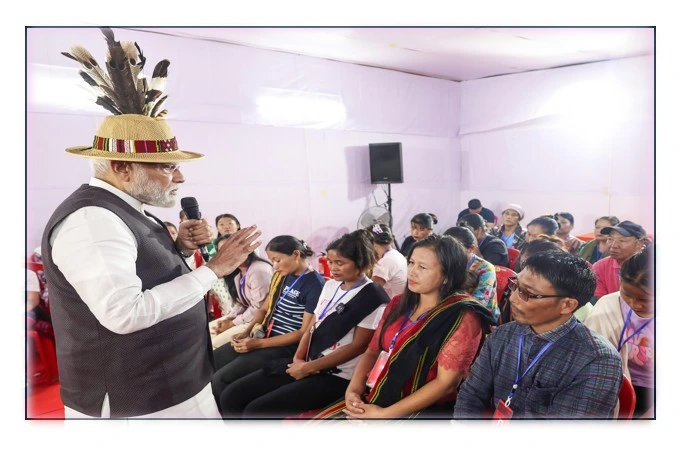
Meghalaya Celebrates 54th Statehood Day Shillong, Jan.21 Giant wooden carvings of Khasi traditional house decorating the main entrance to NEHU campus On a misty morning in January 21 with all hills at Meghalaya being decked up like never before as it marked its 54th Statehood day. Adding his voice to the well-wishers, Prime Minister Narendra Modi sent out love and wish for the people of the “Abode of Clouds,” recognising their contributions in cultural as well as economic life of India.
It is no mere date, however, but one of a peculiar determined resistance and balanced interplay between tradition and progress.
The Abode of Clouds: Exploring Mawphlang, the Living Rootbridge and the Perng (Shillong)’s Concrete Palace
The journey for statehood of Meghalaya is among the most fascinating episodes in the history of post-colonial Northeast India. This shift was end result of a peaceful, constitutional struggle and demonstrated the political maturity of the Khasi, Jaintia and Garo communities.
Meghalaya is a state marked by the “hard-work” of its “kind-hearted people” and their prowess to keep alive traditional culture and harmonious co-living, Prime Minister Modi said addressing the people of the state. He said the State has been contributing to nation’s progress and development, particularly in organic farming, tourism, and sustainable development. The Prime Minister’s greeting signals a larger national vision: the prosperity of India being in the inevitability and inseparability from the emancipation of its northeastern siblings.
A Legacy of Peaceful Transformation
Unlike in so many examples of territorial transfer, which are stained by violence, Meghalaya’s journey to statehood was one marked by dialogue. The Hill State Movement of the 1960s was a lesson in popular mobilization. This was in order to maintain the complete separate matrilineal social structure and its linguistic identity of their highland tribes. The passage of the North-Eastern Areas (Reorganisation) Act in 1971 was a triumph of regional identity within the Indian Union.
Today, after five decades of rule, the state symbolizes social stability. The matrilineal character of the Khasi, Jaintia, and Garo is still very much intact; lineage and inheritances are traced through their mother; but among them there are also some societies which practises similar custom like that of patrilineal system. That cultural foundation has created a model for gender-equitable social architecture that many other parts of the world seek to emulate.
Nature as a National Asset
“Sustainable Prosperity” is one of this year’s 2026 Statehood Day celebration themes. Some of the wettest places on Earth, Mawsynram and Cherrapunji, are in Meghalaya and its biodiversity is a key national resource as India seeks to make good on its climate pledges. The state’s ancient “Sacred Groves” — forests maintained through traditional religious beliefs — offer early lessons in conservation that predate modern environmental movements.
Its message is to Act East as the Prime Minister’s acknowledgement of Meghalaya reinforces the fact that it will serve as a gateway to Southeast Asia. This in not just about macadam and steel; it is also about opening markets for Meghalaya’s now world-renowned Lakadong turmeric and ginger to reach global kitchens.
PM Modi sets 10-year deadline to ‘get rid of colonial mindset
The New Frontier: Innovation and Youth
As much as the state takes pride in its past, the youth of Meghalaya has an eye firmly set on future. Shillong is widely known as the “Scotland of the East” and has transformed over decades from a colonial hill station to a center for education and independent music. Inaugurating the 2026 Statehood Day celebrations, which will see a major thrust on “Start-up Meghalaya”, is an initiative of innovating from local entrepreneurs to address rural needs through technology.
From “living root bridge” treks as part of eco-tourism ventures to a digital platform that connects urban consumers with rural weavers, the spirit of innovation is alive and kicking! The Prime Minister’s message has targeted this young blood, trying to provoke the next breed to lead Meghalaya in making it a “carbon-neutral” state without compromising with its culture.
A Vision for the Next Decade
As the festivities shift from the formal events at the State Central Library in Shillong to local feasts in the Garo Hills, that optimism is tempered with caution. There are still plenty of challenges — not least how to achieve the right balance between industrial growth and environmental preservation, how to increase health care access in far-flung hamlets. But the alignment of state government and central leadership hints at a course charted around holistic “last-mile” delivery.
It is fitting, that Statehood Day should be celebrated on the third of February each year as a day of celebration to remind us that Meghalaya’s strength is in its diversity. The three primary tribes unite in the name of advancement, with their unique dialects and customs. It is this unity in diversity that the Prime Minister’s greetings celebrated — a reminder that the “Abode of Clouds” to which he was referring is not merely a picturesque site, but an indispensable and living part of what it means to be Indian.
This evening, as the sun sets over the Umiam Lake, Shillong will sparkle in anticipation of another year of progress. Now the state approaches its 55th anniversary with a fresh pledge to the ideals of its creation-dignity, peace and a deep appreciation for the land.
