


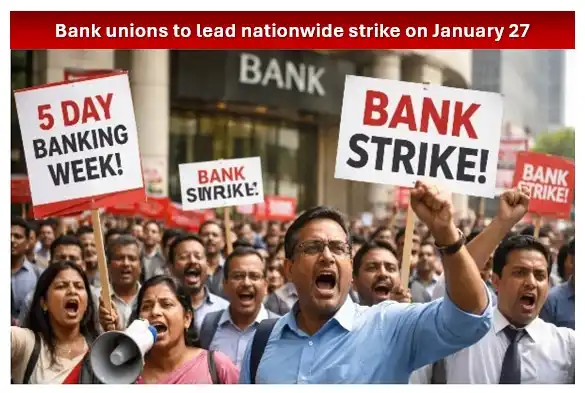
If you were hoping to head to your local bank branch early next week, you may need to rearrange your plans. Millions of clients located all over India are in for a big shake up as the leading Bank Unions have announced a nationwide strike on Tuesday 27th Jan, 2026.
This is more than a mid-week hiccup. Just after the long weekend on account of Republic Day, the strike right in the middle of it means a total of four days of limited or no bank services. But glass doors to thousands of public sector and cooperative bank branches will be tightly closed, even as your mobile app and ATMs continue whirring. Here, from me, is a humanoid deep dive into why this is happening, who it involves and what it means for your wallet.
Why Now? The Long Struggle for a Five-Day Week
The primary friction triggering this strike is one simple demand above all others — the demand for a five-day work week. For years, bank employees have been working in a system where they get the second and fourth Saturdays off, but work full days on the first, third and fifth of every Saturday.
Since April 1,2026 income tax officials may access your bank
A Promise Unfulfilled
The United Forum of Bank Unions (UFBU), the umbrella body orchestrating this agitation, maintains that the government has been dilly-dallying with a transaction which was already “signed and sealed” almost two years back.
The 2024 Agreement: In March 2024, there was an MoU between Indian Banks’ Association (IBA) and the unions. They agreed to give up all Saturdays in return for the speculative 40″ minutes’ work set on by employees every morning.
The Stalemate: Notwithstanding the consensus, there has not been an official notification by the Ministry of Finance.
The Parity Argument-Union heads argue that Reserve Bank of India (RBI), LIC, and leading stock exchanges follow a five-day schedule. Employees of the banks are feeling that they are being unfairly targeted as “second-class financial citizens.”
Following a string of unsuccessful conciliation meetings with the Chief Labour Commissioner this week, unions said “enough is enough,” clearing the way for the walkout on January 27.
Which Banks Are Affected?
The call to strike is national, but its impact will depend on where you have your money.
Public Sector Banks (PSBs): There should be complete or near-total disruption at giants such as State Bank of India (SBI), Bank of Baroda and Punjab National Bank. These are the branches having the maximum number of union members (AIBEA, AIBOC, etc.) and in many places operations may come to a grinding halt.
Cooperative and Rural Banks: The United Forum of Bank Unions has nine constituent units and work force of more than eight lakh employees. That includes regional rural banks and many state-run cooperative banks that are crucial to the agricultural sector.
Private Sector Banks: The impact is quite small on the “new age” private banks (like HDFC, ICICI and Axis). Their employees are generally not members of the striking unions. These banks too, could suffer delays in inter-bank settlement and cheque clearing as the clearing houses are often reliant on participation of the broader public sector infrastructure.
What Will Still Work? (The Digital Silver Lining)
Good news: We’re not in the 1990s. And a bank strike in 2026 would not be a complete freeze on your finances.
UPI, Mobile Banking: Your GPay, PhonePe and mobile banking apps will function as they did. Digital money transfers (IMPS, NEFT, RTGS) are mostly automated and so will not see any impact.
At ATMs: Though there may be no bank employees around to refill them, the majority of ATMs are serviced by third-party cash-logistics companies. But if the strike is predated by high demand over the long weekend, some machines could dry up by Tuesday afternoon.
Online Trading: As stock markets run on different timings than your bank for clearing, you have a clear fund even if the money is not cleared in your bank (In this case, I suppose there should be certain provisions that don’t allow trading until the amount clears).
The Union View: ‘We Are Not Asking for Less Work’
We can all see a strike as some sort of bother, and the fact is, it’s an issue about a modern work-life balance for the bank employee behind the counter. The UFBU General Secretary Rupam Roy had recently said that we have agreed to work more hours from Monday to Friday and have even settled for a 5 day weeks following the Saturday holiday.
“We are not asking to work less hours, we are asking for a structured week that mirrors the rest of the financial services world,” he said. As digital banking has become more widespread, the need for a ‘physical presence’ on Saturdays is irrelevant for the Indian economy to operate, the unions say.
What Happens Next: Can the Strike be Averted?
As of today, it’s January 24 and the stalemate continues. The government is calling on the unions to cancel the strike for fear of affecting an already busy post-holiday period of economic activity. The unions have, however, left such options open only if a formal government notification for the five-day week comes through.
For now, the advice to the public is a simple one: Tie up your banking transactions by this evening. If you have a loan instalment date or a big cheque to clear, don’t wait until next week.
