


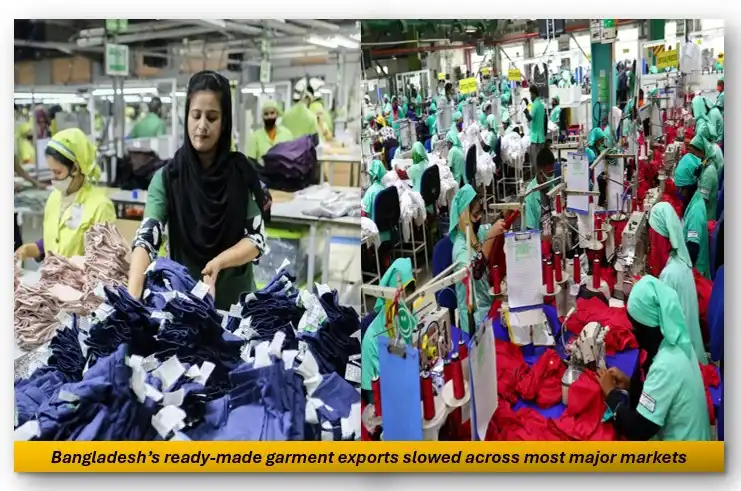
Ready-made garments In the spirit of Eurocentrism, we sometimes forget, all our clothes could have a story. The nation has been one footed in the “factory of the world” for high-street brands, as the second largest apparel exporter at a global level. But as we step into the early part of 2026, the force driving this growth is starting to run out of gas. New data from Export Promotion Bureau (EPB) have dire ramifications: RMG exports are in trouble, slowing across nearly all major international destinations.
In the first half of fiscal year 2025-26 (from July to December), total garment exports declined by 2.63 percent, and this figure, which seems inconsequential, translates into hundreds of millions of dollars when one considers that this is an industry involving relatively low wage labour producing more than 80 percent of Bangladesh’s foreign exchange earnings.
A Chill Goes Around the World: Weak Demand in Old Power Centers
The biggest weight on performance comes from Bangladesh’s top two markets: the European Union and the United States. Traditionally, these markets have been the cornerstone of industry, but are now wrestling with their own economic demons.
The EU market: During H2 2025, Bangladesh’s RMG exports to the European Union – responsible for almost half of the country’s overall garment shipments – dropped by 4.41%. Rising inflation in Germany, France and Italy have led to consumers feeling the pinch, resulting in a “buy less, wear longer” mentality that has hit order volumes.
The US Market: Although the drop in the U.S. was slight (0.1%), it represents an end to a post-pandemic boom. The introduction of new retaliatory tariff regimes, and a change in the way American retailers are sourcing their goods have combined to make Bangladeshi manufacturers’ play more volatile compared with five years ago.
Even the non-traditional markets—heralded for years as the future of diversification to U.S. stocks—were down 3.19%. Attempts to break into markets such as Australia, India and South Korea have been held back by notably pricier logistics costs and less aggressive marketing compared with competitors such as China or Vietnam.
The Perfect Storm: Homegrown Threats and “LDC” Phobia
And while global demand is outside of Dhaka’s control, a host of homegrown problems has made the slowdown even worse. Political turmoil and labor strife throughout 2025 had led buyers to lose confidence. When factories are shuttered by strikes, or out of security concerns, international brands — which work on razor-thin “fast fashion” deadlines — immediately shift their orders to more stable hubs like India or Vietnam.
Out of the street, boardrooms are concerned about LDC Graduation. This is a badge of pride for the country’s development but it comes with a hefty price: loss of its duty-free, quota-free market access in some significant parts. Exporters are already experiencing the “feeling of dread” and battling to drive productivity up to compensate for certain 10-12% tariff hikes on the horizon.
Factor “Vietnam And India”: Increased Competition
Bangladesh is also under a “pincer movement,” from its neighbors. Vietnam has ben the rising star in Man-Made Fiber (MMF)—the synthetic fabrics, like polyester and nylon, that now make up such a huge portion of global athletic and leisurewear. And Bangladesh still relies on cotton –based textile exports for 75 per cent of its overseas sales, Vietnam draws high-end retailers with a more diverse basket.
India, meanwhile, is aggressively marketing its “stability” and an integrated supply chain. Between government incentives, such as the PLI (Production Linked Incentive) scheme, and a manufacturing push by China’s rivals, Indian manufacturers are taking the “small order, high value” segment that Bangladesh has largely turned its back on in favor of working with high-volume, low-margin basics like T-shirts and trousers.
Turning the Tide: A path to 2027
But as depressing as the current sluggishness may be, it isn’t all gloom and doom. Bangladesh still has the world’s largest number of LEED-certified green factories and it is an asset that should (and likely will) prove invaluable as the EU starts to put into force more stringent environmental regulations.
Industry leaders says to get back on a growth trajectory they want:
- Diversifying into MMF high value products and tech textiles thanks to Agri: product Div.
- Digital Integration: By integrating 3D prototyping and AI-based supply chain management, they have been able to reduce lead times.
- Policy support: Government policies to stabilize energy prices and offer low-interest credit to facilitate upgrading of factories during the LDC transition.
The “Made in Bangladesh” tag won’t be disappearing anytime soon. But the days of steamrollering over all obstacles to double-digit growth are finished. The next two years will decide if it can transform into a high-tech, high-value global leader, or remain a “volume player” at the mercy of every shift in the global economic wind.
