


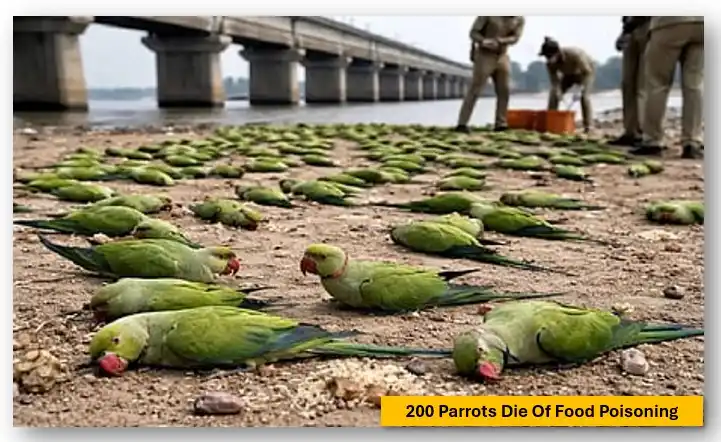
Nature tells us in whispers… but then there are times it screams so loud that the silence is deafening. In the Madhya Pradesh district of Khargone that silence has turned deafening. It’s normally alive with the chattering and green flashes of rose-ringed parakeets, but the local groves have become a place of deep mourning. Hundreds of parrots were discovered dead on forest ground in a grim reminder of the consequences when wildlife is forced to come into contact with humans.
The preliminary cause? Mass food poisoning. This is apparently not a local news sound bite; this is a staggering reminder of how delicate our ecosystem can be and how easily we can shift the balance to tragedy.
The Find That Rocked the World
The scene unfolded in a sleepy pocket of Khargone as locals began noticing a few birds dropping from the trees. A few casualties became many in short order. In mere hours, the ground was carpeted with the emerald feathers of more than 200 parrots. For the locals, who consider these birds part of their daily scenery and agricultural legacy, the image was nothing short of harrowing.
The forest officials and veterinary experts were immediately rushed to the spot. The immediate question: Was this a viral outbreak, like bird flu, that might threaten poultry and people? But the early tests and rapid nature of the deaths looked to be the work of something far more direct: poison.
Tiger Death In Madhya Pradesh Pushes Year’s Toll To Highest Since 1973
Spotting the Culprit: Pesticide or Natural Poison?
Although official forensic reports are yet to be finalised following viscera tests, experts on the ground believe the parrots had eaten grain or fruit contaminated with lethal chemical pesticides. In breadbasket states such as Madhya Pradesh, the human-wildlife conflict over crop protection is a constant tinderbox.
Farmers frequently coat seeds in powerful chemicals to stave off pest invasions. If these seeds are not buried deep enough, or if birds have access to storage sites, then it is disaster. Parrots are social foragers that prey in large flocks. It’s the one-bird-finds-a-food-source-and-all-the-cool-kids-are-doing-it phenomenon. This time, their very sociability — normally the keystone of their existence — proved to be their undoing.
The Role of Chemical Runoff
Nor is it only from direct consumption. Occasionally, after heavy rains, pesticides and fertilizers are concentrated enough in puddles or nearby water bodies to be harmful. A single mouthful of “poisoned” water is all it takes to overwhelm a bird’s nervous system, no bigger than that of a little parakeet.
The Ecological Ripple Effect
200 birds is more than simply a sad statistic; losing 200 parrots is a setback for the local environment. Parrots are known as “farmers of the forest.” In the ecosystem they play a variety of important roles:
- Seed Dispersion: Parrots fly over great distances, and the seeds they discard (or excrete) aid in the natural regeneration of forests.
- Pruning Nature: Eating Fruits And Nuts They also assist in controlling the growth of some trees by eating fruits and nuts.
- Bio-Indicators: Perhaps more than for most other animals it is clear that the parrots are a measure of environmental health. When they die en masse, it’s a canary in the coal mine moment for human safety and soil health.
When a population of that scale is wiped from the face of the earth overnight, the local flora loses its most prolific gardeners, and there’s an instantaneous hole in the food chain.
Balancing Agriculture and Wildlife Preservation
The Khargone disaster is yet another reminder of the crying need for a “humanized” agriculture. I don’t fault farmers for wanting to protect their livelihoods, but we need some compromise between technology and tradition that will allow for the protection of our winged neighbors.
NATURAL OPTIONS: Promote the use of bio-pesticides that kill micro-insects but are not harmful to birds and mammals.
Seed Treatment Safety: Teaching people in communities the value of bagging treated seed and properly disposing of chemical containers.
Community Vetting: Create “safe zones” (AKA community bird feeders) in low food periods to direct swarms away from sprayed fields.
The Forest Department has launched awareness drives in the wake of the tragedy, asking local people to report any such abnormal behaviours of birds. A rat race, against the clock to see that what is left of our flocks don’t suffer the same end.
What Happens Next?
The Forest Department is now cleaning up the area to prevent secondary poisoning of scavengers such as stray dogs or vultures that may feed on the carcasses. Soil and water sampling will be a requirement in the impact zone in the future to make certain these toxins are not lingering.
The skies above Khargone may be a little quieter this week, but with smarter agriculture practices and better education programs, we might see the return of emerald flocks sooner than later.
