


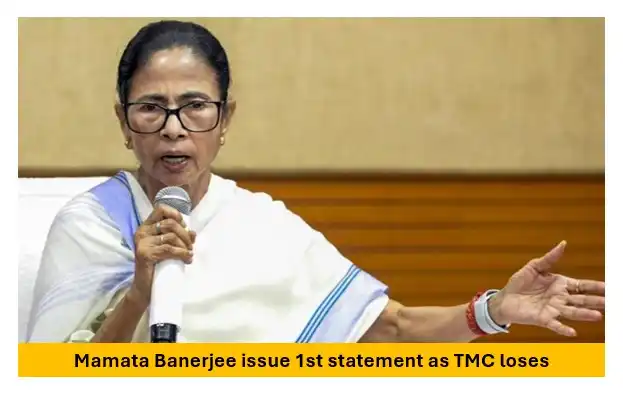
The Trinamool Congress (TMC) has suffered an overwhelming defeat in West Bengal – a territory the TMC has controlled since its birth from Mamta Banerjee in 1998. The TMC will no longer enjoy a monopoly over power in West Bengal and has changed forever, as this loss represents both a seismic shift for the region and a jolt to TMC supporters and detractors alike who have become accustomed to TMC rule during the last decade.
Shocking Verdict in a Political Stronghold
While the loss of seats for the TMC spans a wide range of size and type across the geographical boundaries of West Bengal, certain trends of changing attitudes toward the TMC can be identified by voters across the state. Many observers believe that there are a number of factors contributing to the dramatic reduction and subsequent erosion of TMC’s voter base and strength, including the effectiveness of opposition parties in exploiting local issues, the TMC’s neglect of its party infrastructure and functioning as a cohesive unit, as well as the inability of the TMC to escape the effects of growing anti-incumbency feelings among West Bengal voters. Thus, numerous pundits view the results of this election as a defining moment in West Bengal’s political evolution.
Initial Reaction by Mamata Banerjee
Following the announcement of the election outcome, Mamata Banerjee made an announcement to both party members and the public in a very positive way, using a clear, respectful and strong tone. Banerjee recognised the results of the TMC’s loss but also assured that no matter what happens with the TMC, the people’s voice is always a part of democracy and urged party members to not lose hope.
Banerjee stated “the people’s voice is the most powerful thing in a democracy” and then stated that it would take the TMC some time to review its performance in order to learn from its mistakes. Finally, she promised to support TMC supporters in continuing to provide for the welfare of the citizens of West Bengal.
In this instance, Banerjee was both accountable and defiant: she admitted that previous mistakes could have contributed to this election; however, she also rejected any suggestion that the TMC has lost its ideological foundation.
read more:
- Why will votes be counted on 293 instead of 294 in West Bengal?
- West Bengal and Tamil Nadu witness highest-ever voter turnout
- Retired IFS Officer’s Name Deleted from Voter List in WB
Reward Self-Reflection, Introspection Request
She encouraged her party members to reflect on their own actions. She acknowledged that some of the issues of the election could be attributed to failures within the party, including the failure to have a good communication strategy at times. At a news conference, she did not elaborate on who or what factions should be included in creating discipline and unity of TMC in its future direction; however she did indicate that the organizational structure of TMC could potentially change direction and become more decentralized as opposed to top down.
Political analysts view her statements as a sign of change in the organizational structure for TMC party and its leadership pattern. The TMC may find itself under pressure to evolve from a long-standing vertically structured organization where all of the decision-making power resides within the top tier to a horizontally structured organization where all of the decision-making responsibilities are spread throughout TMC’s leadership team; thus allowing for much more efficient and effective decision making by TMC’s grassroots level supporters and constituents.
Banerjee also stated that there are many different external forces that impacted upon TMC’s failures to successfully win the election, through what has been described by her as a “coordinated efforts of the opposition” and a “very aggressive campaign” by her opposition party and other challengers; however Banerjee has not identified who or which opposition party is being referenced, therefore therefore she called for all of TMC leaders and supporters to regroup.
Opposition Gains Momentum
The post-election results have encouraged the opposition to expand their presence in WB as a result of its elections being considered as an opportunity for implementing a more democratic form of government in WB; thus offering the citizens of WB an accountable and democratic form of government, and that the citizens have therefore without exception, rejected for many years the will of the government without accountability or the accountability of the government.
Repercussions of Resulting Outcome on Future Political Alliances and Strategies
Future outcomes will alter political alliances and strategy on both state and national levels leading into upcoming elections. The momentum established by opposition parties will be important to maintain as TMC’s (Trinamool Congress) immediate priority following this election will be to prevent further damage and to rebuild trust.
Governance and Policy Direction Affect of Election Results
Although there was an electoral defeat for Mamata Banerjee, she continues to hold a prominent role in West Bengal’s political framework. The extent to which this election loss will have an effect on governance will depend on whether it occurs as part of local elections, a by-election or as part of a larger contest.
If the loss results in the party having less legislative strength, it will become increasingly difficult to pass major policy and scheme changes. Nonetheless, due to the fact that Mamata Banerjee has had previous experience with managing government operations and is known for being politically resilient, it is expected that she will continue to be a significant political influencer on the direction of the state of West Bengal.
Continuity Regarding the Priority of Governance
In Mamata Banerjee’s remarks, she clearly conveyed that she was committed to preserving the priorities related to governance that have previously been established. She specifically emphasized TMC’s goals related to social welfare, infrastructure development and outreach to minority communities, which have been major focus areas during her administration.
Directive to Party Workers
A central theme of Mamata Banerjee’s message to party workers was one of staying unified and dedicated. Additionally, she indicated to party workers that internal divisions in TMC may result in loss of strength for the party and not aid any likelihood of achieving success on a political landscape.
“Mamata Banerjee has been through difficult times and emerged stronger,” said the Leader of the Trinamool Congress (TMC) during her speech to party workers after the election results were announced last. She cited past elections where the party had faced adversity but still came through victorious. This statement is seen as an attempt by Mamata Banerjee to consolidate and stabilise her support base by encouraging workers at the grassroots level to remain loyal to the party.
The ‘foot soldiers’ of TMC, those who help to support and build up the TMC party at the local level, will have a critical part to play in determining how fast and/or how successful the recovery of TMC from these recent election results will be.
Looking Ahead: A Test of Leadership
Looking forward, this current situation represents one of the most significant tests for Mamata Banerjee’s leadership in the past several years. During her years of leadership, she has developed a reputation as a fierce and combative leader who has the ability to connect with her supporters at the grassroots level. She is now also faced with the dual task of introspection and reinventing herself as a leader.
According to political analysts, Mamata Banerjee’s actions over the next several weeks, relating to organisational redesigns, policy re-evaluations or enhancing her public relations outreach, will determine the future direction of TMC as an organisation.
If nothing more than the current statement made by Mamata Banerjee indicates that she is trying to strike a delicate balance between acknowledging the election result while not conceding to the losses that were suffered and indicating that change will occur but that she is not weakening as a leader.
As West Bengal enters a new political paradigm, all eyes will turn to Mamata Banerjee and TMC to see how they may work through this very recent and unexpected challenge.
