


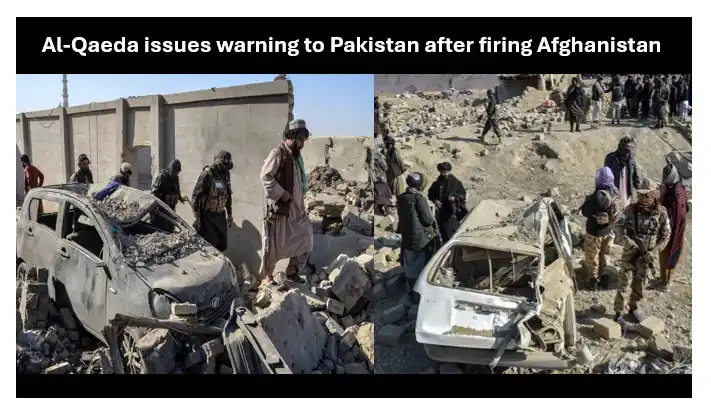
Al-Qaeda is said to have issued a severe warning to authorities in Pakistan after recent incidents of cross-border firing into Afghanistan. Al-Qaeda’s response has amplified the already volatile situation along the Pakistan–Afghanistan border, where there is a long history of insecurity due to multiple factors including militancy, lack of trust between governments and conflicting interests between governments.
Background of the Incident
Sources indicate that Pakistani military forces fired into Afghanistan targeting suspected militant hideouts or in response to perceived threats from within the Afghan border. Pakistani authorities have frequently used these incidents to justify the need to secure their nation against groups that they believe are conducting attacks originating from inside Afghanistan. Afghan officials have historically denied or contested the legitimacy of Pakistani forces’ actions, claiming that these violations of sovereignty have perpetuated instability within their country.
also read: US plans to use Dark Eagle against Iran
Rising Tensions Along the Border
The recent cross-border firing incident appears to have reignited the existing grievances between the two county’s governments. Afghan sources claim that the attack on civilian areas raises humanitarian concerns and has further stirred already heightened anger in the area. Very little official confirmation of recent incidents has been released which has led to a number of militant groups seeking to exploit the situation by fanning the flames of propaganda against authorities.
also read: US delegation’s visit to Pakistan cancelled by Trump
Al-Qaeda’s Warning and Its Implications
According to Al-Qaeda, condemnations of Pakistans actions, threats of retaliation by al-qaeda for future actions such as this are framed by using the notion of aggression towards afghan territory and by extension the interests of the Islamist movement; also, according to security analysts, al-Qaedas involvement may have as much to do with propaganda purposes than operational intention; at this time, al-Qaeda is operating on a much lower level of coordination than what has been typically seen across all years since 9/11.
However, while at the same time, al-Qaeda continues to exist on a regional basis and ideologically through its Affiliate groups; al-Qaeda has made publications of these comments; Al-Qaeda intends to posture themselves to be a protector of Muslim territory, thereby internally generating support among local militant groups.
also read: Trump extends ceasefire with Iran
Regional Security Issues
The warning offers up the possibility that there will be an increase in issues involving non-state actors involved in the region. The Afghanistan-Pakistan border, particularly along the Durand Line, has long been a center of activity for many of the militant groups that are currently working on both sides of the border. The most notable include the Tehrik-i-Taliban Pakistan as well as the Islamic State Khorasan Province (ISKP), and recent developments within Afghanistan have allowed for these groups to continue to operate relatively unchecked.
Pakistan has also expressed a greater degree of concern regarding the presence of militant groups within Afghanistan through their use of Afghanistan as a safe haven to plan and execute attacks within Pakistan, this concern became even more evident with the return of the Taliban to power in August 2021. In response to these Pakistani concerns, Afghanistan has encouraged the Government of Pakistan to address its own security problems independently and without transferring them on to the Government of Afghanistan. The addition of Al-Qaeda to the mix may only create further tensions between the two nations leading to an increase in violence between them.
International Responses and Strategic Implications
There has been relatively little response from the international community to date, but many people are watching the situation closely. The potential for a further deterioration of relations between Pakistan and Afghanistan would provide a serious blow to counterterrorism operations, humanitarian assistance, and future economic projects in the region.
The United Nations and other international organizations have repeatedly called for both parties to engage in dialogue, show mutual restraint, and pursue peaceful solutions. Renewed tensions between Pakistan and Afghanistan, especially involving militant groups, could make attempts to diplomatically resolve the underlying issues more difficult and hinder long-term peace between the two countries.
The Next Steps
Ensuring continued de-escalation is critical in preventing additional deterioration in relations between Pakistan and Afghanistan. Both nations face internal and external pressures to cooperate; however, these pressures will make cooperation necessary. Establishing confidence-building measures, procedures for the sharing of intelligence, and facilitation of clear lines of communication can assist in the reduction of misunderstandings and therefore the minimisation of future conflict.
At the same time, ensuring action is taken to address the root causes of militancy (e.g.: the lack of governance; poor economic conditions and ideological radicalisation) will be very important as, without a comprehensive plan, incidents like the recent cross-border firing will continue and be used by organisations such as Al-Qaeda to provoke more conflict and tension in the region.
Conclusion
The recent warning made by Al-Qaeda regarding the alleged cross-border firing incident by Pakistan into Afghanistan provides an insight into the extremely complicated and tenuous regional security situation. Although the immediate implications of this statement will be minimal, the symbolic implication of this statement is very significant and demonstrates how solely localised incidents can very quickly obtain international geopolitical and ideological recognition. In order to eliminate the potential for escalating additional incidents in an already unstable region, emphasis must be placed on restraint, dialogue, and cooperation.
