


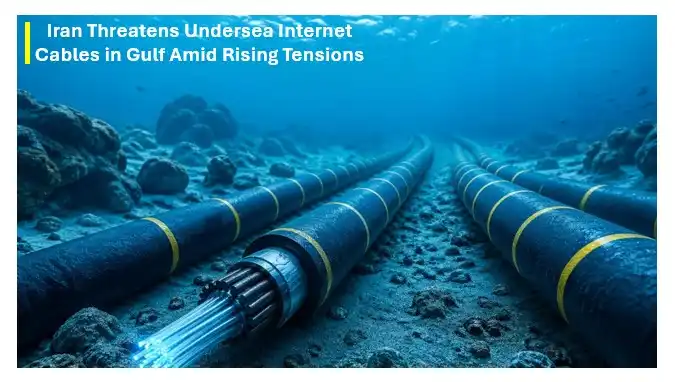
The Iranian Islamic Revolutionary Guard Corps (IRGC) has issued warnings recently that they may attack underwater internet cables in the Persian Gulf area if the tensions between Iran and its Gulf neighbors increase. This announcement raises new concerns for analysts and governments about the potential for new kinds of geopolitical risks related to digital infrastructure.
This warning also comes at a time of increased instability in the Gulf region, with threats to maritime security, energy infrastructure and international trade routes. Submarine cables are responsible for carrying most of the world’s internet traffic and therefore are vital to communications, banking, cloud services and government operations throughout the globe.
IRGC Warning and Strategic Messaging
Through the regional media and through intelligence reports, it is clear that IRGC officials are warning that the submarine fiber optic cables that link Gulf nations could be endangered due to a greater level of confrontation with Gulf neighbors. While not an order to take immediate action against these cables, it does serve as a strategic indicator of how Iran can leverage its influence over critical infrastructure in this region.
Previously, the IRGC has expressed concern over regional energy sources, with the increased emphasis on electronic infrastructure being the latest indication of the shift toward what experts refer to as “hybrid pressure,” meaning that the IRGC is seeking to target physical and cyber-based infrastructures.
Iranian officials claim that these messages are intended to respond to what they perceive as aggressive military and political activities by regional Gulf States and its allies, however other countries have raised alarm over these statements due to the fact that many countries around the world rely heavily on these internet cables.
read also: US turns path waives sanctions on Russian oil sales
Importance of Undersea Internet Cables
The Gulf region sits at the cross-roads of an important global telecommunications pathway. Currently, there are numerous undersea cables between the Arabian Sea and the Strait of Hormuz that serve to connect Asia with both Europe and Africa and digitally connect billions of global users.
These undersea cables provide, but are not limited to, the following:
- International banking and financial transactions
- Cloud computing and data storage services
- Government and military communications
- Internet connection to businesses and individual consumers.
Damage or a loss of today’s undersea cables, even a few, could lead to increased latency; outages, as well as significant changes in routing due to the need for rerouting over either longer or less expensive paths. Analysts are stating that if multiple cables were damaged simultaneously there would be a “system-wide” impact felt across the globe.
read also: Iran opens Starit of Hormuz
Escalating Regional Tensions
Alongside increasing geopolitical tensions throughout the Gulf, particularly relating to maritime chokepoints (e.g., Strait of Hormuz), the internet cable warning is taking shape. The area has historically been a flash point for tensions surrounding shipping lanes, naval activity, and oil exports.
Examples of some recent developments include:
- The seizure and inspection of commercial vessels
- The threat to energy infrastructure of Gulf States
- Continued diplomatic standoffs with the Government of Iran and an opposing Government aligned with the west.
The competition between many nations worldwide regarding infrastructure (pipelines, ports) has now expanded to include internet cables.
Iran has a long history of controlling or limiting internet access within its borders during times of civil unrest. In previous events, Iran’s Government imposed a nationwide shutdown or totally restricted internet access to limit the movement of people and information during protests.
However, if Iran were to target external infrastructure (e.g., cables), it would create a relatively unmeasurable level of external cross-border variables that could affect more than one country simultaneously.
read also: LeT Co-founder Amir Hamza Shot in Pakistan
Global Concerns Over Digital Infrastructure Security
The alarming warning about increased discussion between various cybersecurity experts, governmental agencies, and others concerning the security of undersea cable systems this month has resulted in growth of concern that some of these systems are very poorly protected for how important they are to the world (i.e., these cables extend across vast distances along the ocean floor).
Several experts have stated they are concerned with:
- Physical sabotage would be very difficult to prevent.
- Once damaged the cable would take weeks or even months to repair.
- Multiple cuts in critical areas could result in the isolation of an entire country from the rest of the international community.
- Increased insurance and shipping costs would be incurred in those areas affected by cable damage.
Due to these potential risks to human life and commerce, the world has viewed undersea cables as critical infrastructure that requires coordinated protection policies by all countries that rely upon these systems.
Negative Impacts to Countries Within the Region and Globally
If there were to be a disruption caused by damage to undersea cables, countries in the Gulf Region (i.e., UAE, KSA, Qatar, and so forth) would experience immediate and serious connectivity issues due to their reliance on global data connections for Finance, Energy Trading, and Digital Services.
The negative effects from damage caused by a disruption to undersea cables would not be limited to the Gulf Region, but would also cause significant negative effects worldwide, such as:
- Delay of international data routing across undersea cables.
- Increased latency of global internet traffic.
- Disruption of cloud services located in the Gulf Region.
- Financial Losses in sectors that depend on digital technology for their business practices.
Since the Gulf Region serves as a major hub or transit point for global transmission of data, the negative effects would not be limited to the Gulf Region alone.
Diplomatic Uncertainty and Outlook
While the IRGC’s statements have caused some concern, there are no known reports of any active sabotage or immediate threats to Iran’s operational abilities at this time. Analysts interpret Iran’s statement as part of its overall deterrence strategy in light of increasing regional pressure on the country.
Although diplomatic channels continue to be strained and the situation continues to change, ongoing disputes in both the maritime and energy sectors create additional diplomatic pressure. Many observers worry that if there is a significant increase in tensions within the region, then the lines will be blurred between traditional military conflict and cyber or infrastructure warfare.
Bottom line
The warning from Iran about its ability to disrupt undersea internet cables in the Gulf highlights that modern geopolitical tensions have become increasingly intertwined with digital infrastructure. While no known disruptions have occurred, the statement serves as a reminder of how fragile the global connectivity system is and how targeting such systems during regional conflicts could have significant ramifications.
In addition to adding concern about a new issue, the situation in the Gulf is becoming more complex as it relates to energy security, shipping routes, and now the internet, all of which factor into the increasing strategic competition in the region.
