


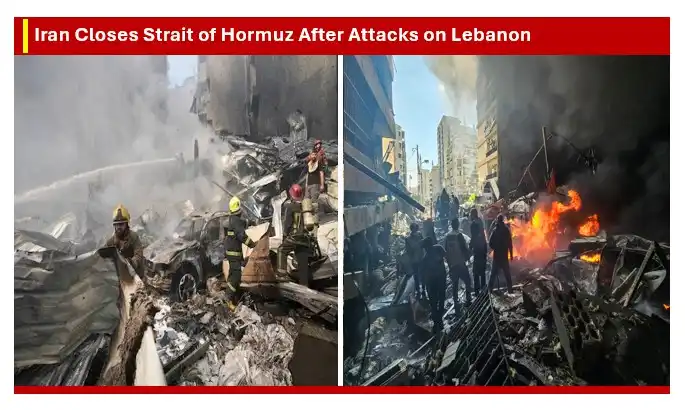
The fragile ceasefire between the United States and Iran has been greatly compromised with the recent Israeli aerial bombardments of UN troops in southern Lebanese territory. The tenuous ceasefire had raised hopes of a possible Iranian re-opening of the STRAIT OF HORMUZ, a critical global oil shipping artery; however, the new attacks on Lebanon have dashed those hopes and added further volatility to the situation in the Middle East.
It is clear that Iran has successfully maintained total control over one of the planet’s most significant commercial choke points for worldwide energy transport.
Background: A Fragile Ceasefire Collapses
Incidentally, Iranian officials cite the recent Israeli air attacks against targets in Lebanon as the reason why they have made this decision. They assert that these strikes constitute a violation of the spirit of the current ceasefire and warrant a reprisal from Iran within the Straits of Hormuz.
The United States has disagreed with Iran’s assertion and stated that the air attacks against targets in Lebanon do not constitute a condition precedent to the previously defined ceasefire agreement.
Accordingly, the United States is asserting that the air attacks carried out against Hezbollah by the State of Israel are not related to the U.S/Iran arrangement and thus demonstrates a significant rift in the two countries’ diplomatic understandings. In addition, this disagreement has made further attempts to stabilize the region all that more difficult.
read also: Pakistan court supports marriage of 13 year old Christian girl
Commercial shipping and energy supply consequences
Approximately 20% of all oil traded in the world flows through the Straits of Hormuz, thus, it goes without saying, any disruption to this trade passage would be of great international concern. An average partial closure has resulted in hundreds of vessels being diverted or stranded, and shipping companies are increasingly unwilling to risk moving any vessels through this passage without clearly defined and guaranteed security.
Experts in the shipping industry have stated that normal shipping traffic through this maritime passage will likely take months to be restored even if tensions are resolved, due to the insurance premiums, security exposure, and uncertainty associated with discovered risks that continue to weight heavily on owners of vessels moving through this waterway.
Global energy markets have experienced increased instability as a result of international disruptions; there are now fears of potential shortages within the supply chain. Prices remain volatile and subject to price fluctuations as a result of these fears, with the possibility that they will have an economic effect globally.
read also: US Aircrafts used to rescue its 2 pilots from Iran
Military Control and Conditions of Passage
Iran has developed new methods for controlling navigation by restricting access to only those vessels which are “non-hostile,” and enforcing stringent measures of observation during the transit of such vessels. Consequently, vessels are being diverted from their former routes to be monitored while passing through Iranian territorial waters, reflecting increased security protocols.
The level of military support that the Iranian military has provided in overseeing transit demonstrates a growing militarization of the waterway. Analysts point out that the new procedures do not provide sufficient security for normal rights of international navigation and raise concerns regarding freedom of transit for an extended period.
International Response and Efforts to Resolve Issues
The international community has reacted with concerns about these developments, urging a de-escalation of tensions and the reopening of the Strait of Hormuz. Reports indicate that France and other countries have been coordinating programs to facilitate and protect safe maritime access to the Strait, while at the same time working towards a comprehensive framework for peace that includes Lebanon.
European leaders have expressed the necessity for a lasting diplomatic solution and warned that if the disruptions continue, there will be an increased risk for a more extensive worldwide economic crisis.
Additionally, the United States has issued condemnation to Iran, demanding the immediate restoration of freedom of navigation.
A Widening Regional Crisis
It can be seen that there is an ongoing regional war involving not only Iran but also its ally and enemy states including Israel which are fighting on different fronts including Lebanon and in the Gulf region of the world. Since this period of heightened crisis started earlier this year in 2026 due to ongoing hostilities between various parties involved in the crisis, numerous commercial vessels have been attacked via missile attacks, and numerous naval vessels have been attacked via other means.
Iran’s actions show that the Strait of Hormuz will continue to be a primary area where Iran will be exerting pressure in relation to the conflict because any developments in relation to the crisis will be tied directly to developments outside of the Gulf Region.
