


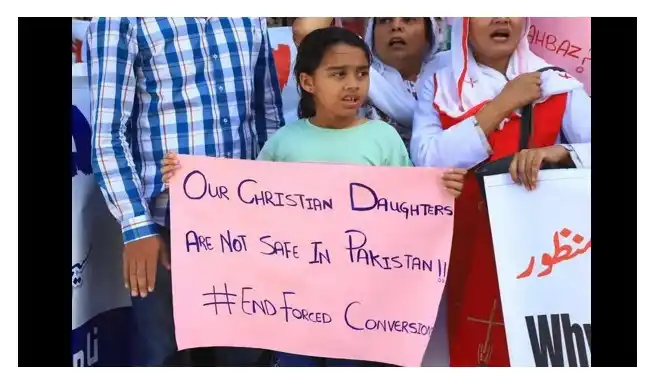
Recently, there has been an important ruling from the Pakistani judiciary regarding child marriage that has caused great controversy and has raised concerns relating to the welfare of children with respect to the treatment they receive from the court, as well regarding the treatment of minorities under the law in Pakistan. Further, the groups advocating on behalf of children’s rights have stated that this ruling illustrates the deficiencies in both child protection laws and minority rights laws presently existing in Pakistan’s statutory framework.
Court Ruling Sparks Outrage Over Child Marriage and Minority Rights
This particular case has garnered a lot of national media attention lately after a 40 year old Muslim man married a 13 year old Christian girl. According to the family of the girl she was abducted, converted from Christianity to Islam against her will, and forced into marriage with the man. The male asserts that the marriage was consensual between the parties and must thus comply with the requirements of sharia (Islamic) law.
The court’s role was to determine whether the marriage was legal under Islamic law, whether the female was of legal age at the time of the marriage, and whether there was any proof of coercion if the marriage took place prior to the female reaching an age at which marriage contracts can be validly formed under the law.
read more: US Aircrafts used to rescue its 2 pilots from Iran
Court’s Justification
The judges found that based upon Islamic interpretation of sharia law (the concept of puberty), that the marriage was lawful and thus valid as a result of both religious and legal authority. The judges also hypothetically based their decision on the testimony (sworn statement) of the girl, who allegedly verified during her testimony that she wished to continue the marriage.
This decision raises the issue of the role of personal laws in Pakistan’s legal system, where different religious groups are subject to different legal frameworks.
read more: Gunfire reported near White House
Legal Contradictions and Child Protection Issues
To critics, this ruling has a contradictory view with regard to the already existing child protection laws in Pakistan, which state a minimum age to marry. In numerous areas, the minimum age for girls to marry is sixteen, albeit it is scarcely enforced.
Legal scholars have cited that civil law has a significant overlap with various religious interpretations of law that create the possibility that child marriages can be legally accepted as a function of the right to practice one’s religion freely. The debate surrounding the case’s outcome is central to the ongoing discussion of whether or not all children have the right not to be married, regardless of the governing laws of religion.
read more: Secret Damage Uncovered After Iran Drone Strike
Rights of Minorities
The case has heightened concern for the plight of religious minorities in Pakistan, particularly Christians, and Hindus, who continually report instances of forced conversions and marriage with minors.
Advocacy groups assert that minority families face significant difficulties when attempting to obtain justice, including societal discrimination, poor access to legal assistance, and fear of retaliation for exercising their right to obtain justice through the courts. Advocates believe that the ruling could set a bad precedent for minority communities and perpetuate discrimination against those individuals.
Reaction from Human Rights Organizations
Both local and international human rights groups have condemned the court’s decision. They say that no minor is able to legally and/or ethically consent to marry, especially under conditions of coercion and/or significant power disparities.
Immediate reform has been requested by activist groups, including stricter enforcement of minimum-age laws, stronger protective measures for minors, and clearer separation between civil and religious law.
The Ruling has caused a social media explosion in Pakistan with many individuals expressing concern for child welfare and inconsistencies in law. There have been many different opinions shared about this issue from those that support religious freedom to those that would like stronger protection for minors.
Broader Implications
Government officials have not yet indicated any immediate policy changes, but this case has helped [revive] legislative reform efforts to provide for greater and ongoing supervision over cases involving minors.
This case is indicative of a much larger issue for many countries as they attempt to balance their legal systems between respecting traditional religions versus their obligations to adhere to international human rights standards. The conflicting legal systems create potential for abuse to those most vulnerable, particularly young girls.
Experts are cautioning that unless there is a framework for laws that support and consistently apply legal protection, instances of child marriage will persist and hurt the efforts to end child marriage as well as create additional obstacles for minority individuals and groups who seek protections.
Final Thoughts
The court’s confirmation of the child’s marriage to a 40-year-old man raises a complicated and emotional controversy in Pakistan. The ruling is based on certain factual and religious definitions, but creates controversy regarding areas of child protection, consent, and the protection of minority rights. With continued pressure from activists and others around the world, this case may become a turning point from which to launch a discussion regarding justice, legal reform, and the protection of vulnerable persons and groups.
