


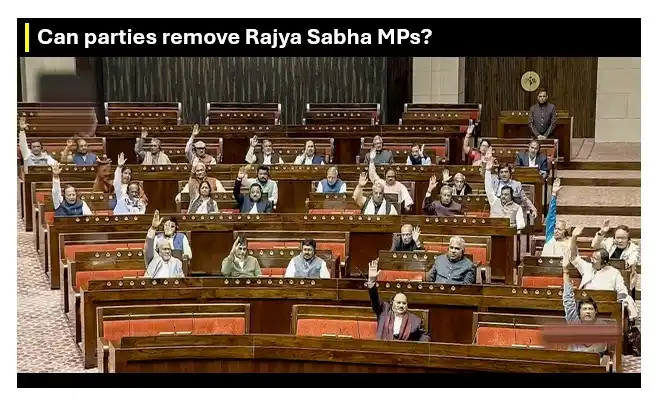
In a new political uproar Raghav Chadha was removed by the Aam Aadmi Party (AAP) from being its Deputy Leader in the Rajya Sabha and the party also requested the Secretariat not to allocate any speaking time to him, further complicating the political situation.
Political storm triggers constitutional question
Chadha called the move “pre-planned” and politically motivated, while the leaders of the party claimed that this was an internal decision.
However, aside from the political ramifications involved, this incident has raised a significant constitutional question: Is it possible for a political party to remove its Member of Parliament from the Rajya Sabha?
How are Members of the Rajya Sabha Elected?
To have an understanding of this issue, one needs to look at how the Members of the Rajya Sabha are elected. The Rajya Sabha is Unlike Members of the Lok Sabha, who are directly elected; Members of the Rajya Sabha are elected indirectly by the elected Members of the Legislative Assemblies of the states through the use of the Proportional Representation method.
Members of the Rajya Sabha serve a fixed six-year term and the Rajya Sabha is a permanent body as one-third of its members are going to retire every two years.
This makes the members of the Rajya Sabha receive their authority from the Constitution and the electoral process; they do not have their authority through the Leadership of their respective Political Parties.
Can parties remove Rajya Sabha MPs?
The short answer is: No, political parties cannot remove a Rajya Sabha MP from Parliament.
Constitutional principles state that once elected an MP has an entitlement to their position and does not need permission from their party to keep their position as an MP.
There are specific legal/constitutional reasons that allow an MP to lose their position as an MP, including:
- anti-defection laws disqualify them from being MPs.
- resigning.
- receiving a sentence for certain criminal activities.
- being legally removed by a Government Authority.
Discipline of an MP by their political party through internal disagreement is not sufficient to remove them as an MP.
What control do political parties have?
MPs cannot be removed from the Rajya Sabha by a political party, however, a political party maintains a great deal of control over the internal functions of MPs.
Control by a political party over how to manage their internal functions includes:
- appointing/removing political party leaders (deputy leader, floor leader, etc.)
- determining MPs’ speaking time in the House.
- determining MPs’ parliamentary obligations.
- determining the disciplinary actions to be taken against MPs.
As in the case of Chadha, AAP did use its created authority to remove him from being a leader in AAP and to limit him to only participating in limited debate of issues in Parliament.
Thus, the AAP action was politically significant but constitutionally limited. The grey area is the anti-defection law.
The anti-defection law creates a means for disqualifying an MP if:
- An MP votes against the direction of the political party (whip), or
- An MP voluntarily resigns from their political party.
The Rajya Sabha’s chairman, not the political party, however, gets to make the final choice on any candidate’s appointment (membership) as a Rajya Sabha member.
This exemplifies the essential principle:
The political party may recommend or raise complaints about a member of parliament but cannot unilaterally remove them.
Chadha’s situational significance:
The Raghav Chadha issue illustrates that a political party has significant limitations on controlling a member of parliament in an Indian parliamentary democracy.
Even though AAP (Aam Aadmi Party) is indicating internal dissatisfaction and reconfiguration with the Chadha situation, this also suggests:
- A member of parliament has an independent constitutional status.
- A political party’s authority is exercised within only cooperative boundaries (mostly).
- There are two distinct roles (parliamentary vs. member of parliament).
The incident also reflects a lack of harmony among AAP leaders, with some attacking one another and others responding to those attacks in public.
Political versus Constitutional authority:
This case illustrates the extent of the difference:
- Political Authority Constraining Authority
- The party leader’s actions The Constitution of India
- A party’s internal (leader and whip) roles Membership within parliament
- Allocating time for speeches Tenure and disqualification provisions.
In simple terms:
- Party = controls position and influence
- Constitution = protects membership
Bottom line:
Current conflicts challenge a basic premise of Indian political life. Political parties do not have the legal authority to expel their Members of Parliament (MPs) from the Rajya Sabha.
Instead, political parties can only limit the role, power, and responsibilities of their parliamentarians within the party’s organizational framework.
Raghav Chadha provides an example that illustrates the interplay between the mechanisms of party discipline and the constitutional autonomy that is necessary for a functioning parliamentary democracy in India.
As political contests are waged, this distinction allows for accountability of those elected leaders not only to their political parties, but also to the democratic system through which they were elected.
