


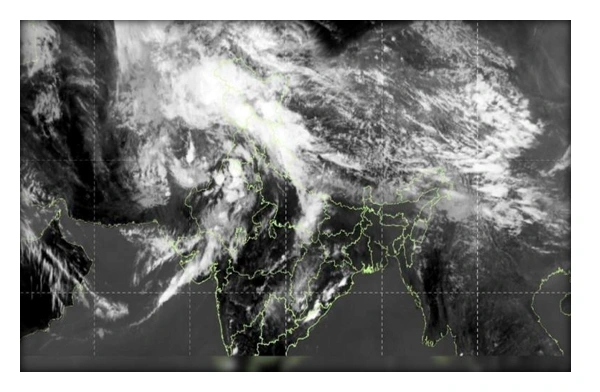
The India Meteorological Department (IMD) recently published satellite images showing a huge cloud structure that spans almost 1,000 kilometers across sections of India and Pakistan. This thick, extensive cloud coverage indicates that a weather system is currently developing across the areas of northwestern India and adjoining areas of Pakistan, creating a higher chance for widespread rainfall and thunderstorms in these areas in the days ahead.
What can be seen through the Satellite Images?
In the satellite photos, there is thick multilayered cloud cover throughout northwestern India and adjacent areas of Pakistan. This cloud cover collectively stretches over significant portions of Jammu and Kashmir, Himachal Pradesh, Punjab, Haryana, and part of Rajasthan.
Meteorologists observe that regional extensive cloud ban typically have very high moisture levels with instability within the atmosphere. The western disturbance is moving from west to east; thus, other parts of India could be affected by this cloud formation as well.
What is Causing the Cloud Formation?
This large cloud formation is primarily being caused by an active western disturbance originating from the Mediterranean region, which is moving westward to reach the Indian Subcontinent (ISB).
The current disturbance in the atmosphere has interacted with a cyclonic circulation and trough located in the upper atmosphere that extends from Rajasthan to the Arabian Sea. These two systems have created extremely unstable atmospheric conditions, which leads to great potential for rain, thunderstorms, and clouds to form.
The following States of India are likely to see conditions changing due to this disturbance, according to a recent announcement from the India Meteorological Department (IMD):
- Jammu and Kashmir
- Himachal Pradesh
- Punjab
- Haryana
- Rajasthan
- Uttar Pradesh
- Madhya Pradesh
- Chhattisgarh
Rainfall activity is expected to develop over the course of the coming days from northwest India to central India. The disturbance is having an impact on parts of Pakistan as well.
Weather Professionals are expecting a variety of weather events to occur in the affected states, including regular rainfall, thunderstorms, lightning strikes, and strong winds. In some areas, wind gusts could exceed 40 to 60 kilometres per hour during a thunderstorm.
In addition to the potential for some areas to receive a few short and intense rain showers, hail could also be an issue in hilly and foothill areas as well. Additionally, during these events, the temperature could drop suddenly.
Impact on Daily Life and Agriculture
While the upcoming rainfall will provide temporary relief from rising temperatures, it could also disrupt everyday life. Urban centres could experience flooding, congestion, and visibility problems due to heavy rains.
Farmers have been warned to exercise caution because unseasonably cool temperatures and hail damage to crops could disrupt standing crops. There could also be disruption to agriculture and harvesting activities in certain parts of the region.
Cooling Down—For Now!
The clouds and rain are expected to reduce overall temperatures in the entire North Indian region considerably; thus, we will get short-term relief from early summertime conditions. According to meteorologists, though, you need to keep in mind that the temporary nature of this relief may not last.
After the western disturbance moves out of the area, the atmosphere will begin to heat back up, and you could be seeing hot temperatures again soon—perhaps even hotter than normal!
Observed Patterns of Weather Recently
Interestingly, this type of weather is not new. Recent weather patterns have shown that a similar large cloud formation occurred about a month ago to the same western disturbance.
Therefore, we see a pattern of relatively frequent and large fluctuations in weather in the transition from spring to summer, although that is quite common, rapid, and extreme changes in weather will normally occur during this time.
Read also: NASA Crew-12 Soars as SpaceX Falcon 9 Roars Into Orbit
What Happens Next?
The next 48 to 72 hours will be pivotal in assessing how severe and how far reaching the effects from this weather system will be. The IMD is monitoring the weather system very closely and has encouraged people to check official weather sources for updates. Another western disturbance is projected to impact the region right after this system has passed through, which could lead to a longer duration of unsettled or unstable weather.
Final Summary
The presence of a continual 1,000 km long band of clouds over India and Pakistan gives an indication of the severity and size of this current weather system across northern India and into western India, which, due to a strong western disturbance, will cause heavy rains, thunderstorms and strong winds in the northern and central parts of the country.
While the system will bring an end to hot weather conditions, it will be damaging to farmers and make daily life difficult. With more weather systems expected over the coming days, the weather will likely present a significant degree of volatility throughout this part of the world.
