


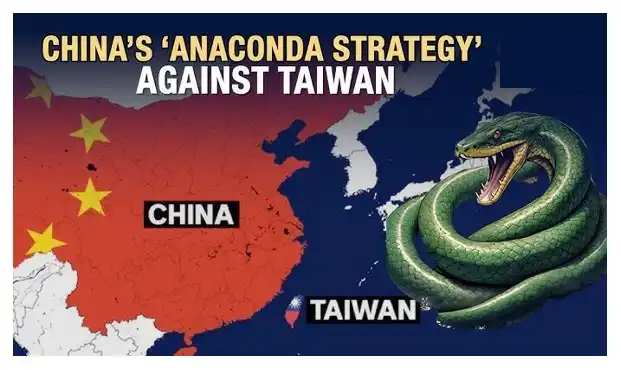
China’s Anaconda Strategy describes a long term method of pressuring Taiwan, without initiating a full military invasion, mirroring how an anaconda constricts its prey before eating it. The method of increasing pressure on Taiwan does not rely solely on military actions; it combines military exercises, the use of economic resources, diplomacy, and psychological pressures to apply sustained, gradual pressure to Taiwan until its ability to resist has been diminished.
Developments in the last few months suggest that China has increased its military presence around Taiwan, including large-scale naval and air force exercises surrounding Taiwan and simulating a Chinese blockade on Taiwan and/or Chinese air strike operations to eliminate the military shortcomings of Taiwan in order to demonstrate their capability to limit Taiwan’s access to the outside world.
Military Pressure and Gray-Zone Tactics
In addition to these military developments, China has stepped up its usage of “grey-zone” tactics which are actions that are not technically acts of war, but are meant to coerce or intimidate another nation into submission. For example, Chinese fighter planes routinely fly across into Taiwan’s ADIZ/ADIS which forces Taiwan to scramble a number of its military aircraft to intercept them, thus exhausting both Taiwan’s military resources and their psychological resolve.
The overall purpose of the Anaconda Strategy is to weaken Taiwan through sustained psychological and military pressures until such time as resistance to the accumulated pressures has become prohibitively costly to continue.
read also: Uganda Calls for Restraint Amid Rising Iran Conflict
Economic and Diplomatic Isolation
China is putting military pressure on Taiwan, but is also working to internationally isolate Taiwan by attempting to pressure countries and organizations from officially recognizing Taiwan thereby limiting the usage of diplomatic channels by Taiwan. China also uses its large economy as leverage against Taiwanese companies to discourage foreign companies from engaging with Taipei.
Additionally, China has selectively used trade restrictions, targeted sanctions, and limitations on tourism to message that there are political costs for defying China.
read also: Sri Lanka Increases Fuel Prices by 24–30%
Information and Psychological Warfare
China also employs multiple layers of information and psychological warfare through the use of media, cyber, and disinformation campaigns to attempt to shape public opinion of Taiwan and abroad to instill doubt about Taiwan’s security and influence the level of public morale negatively and make unification appear to be inevitable.
Taiwan’s Response
Taiwan has begun to develop and indices in defence against China’s military through increased defence capability, enhanced relationship with allies, and funding asymmetric warfare capabilities (ex. mobile missile systems and cyber defence) to counter the intention of an overwhelmingly large military force. Taiwan has also increased efforts to combat Chinese psychological pressure through increased public awareness of the pressures exerted by China and increasing Taiwan’s resilience to withstand a psychological assault.
Global Implications
The Anaconda Strategy will create global fear, especially among countries such as the US and those in the region. Additionally, the continued use of gentle coercion would create severe disruptions in global supply chains, specifically with semiconductors, and create increased tensions in the Indo-Pacific area.
Conclusion
China’s Anaconda Strategy is nothing more than a long-term program of pressure to slowly coerce Taiwan into submission rather than an immediate attack. To achieve these objectives without taking on the risk of military attack, Beijing employs a combination of military coercion, economic manipulation and information warfare.
