


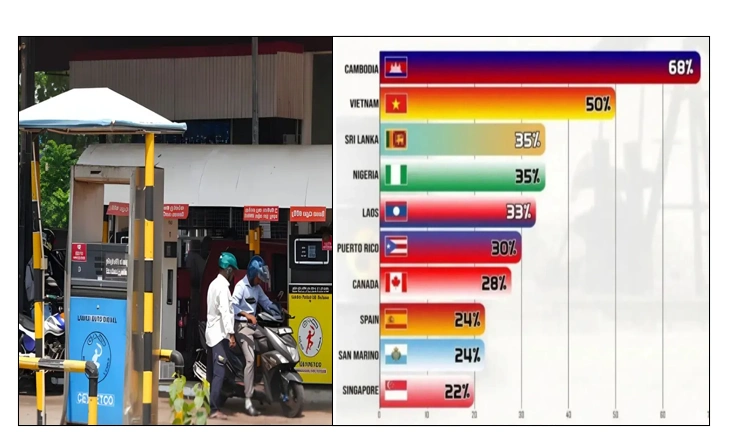
It was anxiety of a kind that had come to be known in Colombo. When twelve struck, the digital readings in Ceypetco and Lanka IOC stations changed and the numbers were much more welcome by many Sri Lankans, with whom they never wanted to see again. The state-owned Ceylon Petroleum Corporation (CPC) formally sanctioned an appalling 24-30 percent increase in the prices of all the fuel products, an action that was necessitated by a fragile global oil market that was pushed to the edge due to the growing conflict in West Asia.
These new prices, which have catapulted Petrol 92 to Rs. 398 and Diesel up to Rs. 382 are not merely figures to a country still recovering the shocks of the 2022 economic meltdown. They are the stranglehold on the livelihood of millions of people.
A Mathematical Surge of Weights of the World
The geography of pains of Sri Lanka is based much beyond the shoreline. As the world oil standards shot up between $90 and almost 139 a barrel within a couple of weeks, the cost-reflective pricing formula adopted by the government did not provide much room to play. The awful arithmetic, explained by president Anura Kumara Dissanayake in a speech to Parliament, goes as follows: with each 1 per cent rise in the global price of oil, the domestic pump price would have to go up by about Rs. 2.00 to ensure that the energy sector remains afloat.
The present surge which is a result of the unrest in the Strait of Hormuz, a crucial passage through which a fifth of the global oil is passed has resulted in a blow from both sides. The base cost of crude is not only up by 40 but the premiums that are required by the suppliers to take the risks of transporting the product into the region have also shot up.
Read also: Iran sent 11.7 million barrels of oil to China via the Strait of Hormuz
The human cost of energy (Life at the Pump)
The increase is experienced more visibly than the balance sheets of the CPC, in the silent desperation of the morning commute. The “fuel queue” has reappeared in the outskirts of Colombo and the countryside of Anuradhapura not as a permanent phenomenon yet as a spectre of 2022 that is haunting the present.
To Nuwan, a three-wheel driver whose livelihood solely relies on the price of Petrol 92, to facilitate the increase of the price of Petrol 317 to Rs. 398 is a direct blow to his family dinner. Tank fill up, or full day of work, every time I fill the tank, that is what he says, leaning against his vehicle. We had just got the breath of life back again. It is sort of as though the air were being squeezed out now.
The symptoms of this are short-term:
- Transport & Logistics: School fares and school bus fares will follow and this will place an immediate burden on the parents.
- Agriculture: With Diesel surging to Rs. 382, farmers who confront the March planting season cannot consider the expense of machinery and transport almost bearable, which will jeopardize the food security in the latter half of the year.
- The Kitchen Table: Kerosene, the breadwinner of most low-income households, and the fishing sector, drastically went up by Rs. 60 and stood at Rs. 255 per liter.
Read also: Petrol Bomb in Pakistan- Fuel Prices Jump by PKR 55
A Weak Revival on Tiptoes
It has been a high stakes tightwalk to economic recovery by Sri Lanka. The inflation rate that reached nightmarish 70 percent in 2022 had been brought under control to about 1.6 percent early this year. The oil is however a cost-push factor that spills over to all sectors. Analysts caution that the Colombo Consumer Price Index (CCPI) will keep on an upward trend with the transport and manufacturing prices being transferred to the consumer.
The government has tried to cushion the impact by raising the weekly fuel quota under the QR code system of 15 to 25 liters of fuel but to many the problem is no longer the quantity of fuel but the price of it, which is very costly nowadays. As the rupee comes under the pressure and as the foreign reserves are put to the test by the swelling import bill, the Central Bank has a hard decision that it has to make between saving the currency and letting the market to absorb the shock.
