


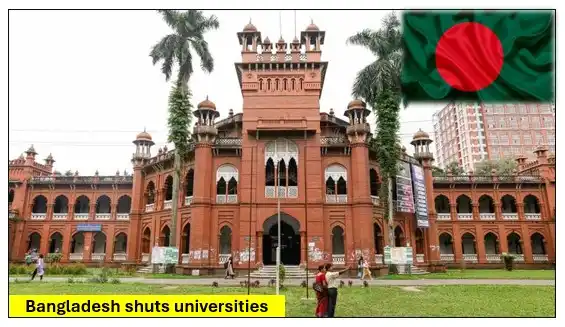
The government of Bangladesh has ordered the closure of all public and private universities across Bangladesh as part of the measures to mitigate the worsening energy crisis in Bangladesh. In response, the Bangladeshi government has moved the Eid-ul-Fitr holidays to Monday from Monday to reduce the amount of electricity used in the nation and to reduce fuel use throughout Indonesia.
The Bangladeshi Education Authorities issued this order for all universities in Bangladesh as part of a broader campaign to conserve energy in order to manage the crisis.
The officials stated that the decision would help to reduce the electricity used by large universities, which generally use much of their power for classrooms, laboratories, air conditioners, and dormitory buildings. It is anticipated that by temporarily closing university campuses, this will relieve pressure on the national power grid and will decrease fuel use.
Energy Crisis Linked to Global Conflict
Bangladesh is facing an increasing amount of uncertainty regarding energy imports because of the disruptions occurring in the world fuel markets due to the continued violence in the Middle East, which is raising the prices and disrupting the supply of oil and/or natural gas to Bangladesh, among other countries.
The 95% of the country’s energy supply resulting from imports makes Bangladesh extremely sensitive to fluctuations in international prices and instability due to geopolitical issues. Increasingly, countries that import oil and gas, including Bangladesh, are suffering financially due to a lack of supply as a result of the region’s war interrupting energy exports and increasing costs.
read also: Power transition in Iran amidst war and political turmoil
Electricity Conservation and Fuel Decrease Measures
The university’s closure is part of an extensive government effort to address the lack of electric energy related to university operations. After the panic buying and stockpiling of fuel at gas stations occurred some months ago, fuel distribution was halted entirely.
Foreign-curriculum schools and private tutoring were also asked to suspend their operations for now to reduce electric power consumption. By encouraging educational institutions and citizens to minimize the use of electrical power (for example by minimizing the amount of artificial lights (using natural daylight)) there should be a decrease of electric energy consumed.
Government officials feel that these actions can assist in conserving energy until more fuel supplies can be secured.
read also: Iran Names Mojtaba Khamenei as New Supreme Leader
Gas Shortage Hits Industrial Production
The energy crisis is having a huge impact on several critical areas of the economy. The government is shuttering 4 of the state-owned fertiliser factories after a severe shortage of gas led to the government transitioning gas to generators from industry to avoid large-scale shut-offs of electricity.
The current shift reflects the government’s desire to prioritise electricity generation over industrial production as an effort to address the emergency situation created by the gas shortage. However, experts are warning that if gas to produce fertiliser is not restored soon (and production of fertiliser is not ramped back to normal rates), agriculture and food production will be severely impacted by the long-term loss of the ability to produce fertiliser for crops and animals.
The Government of Bangladesh will purchase liquefied natural gas (LNG) on the global spot market because of this urgent need for additional LNG. However, LNG purchased from this market has a substantially higher price than long-term contracts for customers who utilise the spot market to purchase LNG. The government is investigating opportunities to obtain as much LNG as possible, as these purchases are required to allow Bangladesh to produce power and sustain a stable fuel supply to the nation’s economy while the overall energy market is in a volatile state.
read also: Petrol Bomb in Pakistan
Impact on Students and Academic Calendar
The universities closing temporarily has a chance of affecting their academic calendars if the situation does not improve. Authorities stated that closures would coincide with Eid, which coincides with the time period at which many universities planned to start their holiday. There are instances where some institutions intended to start their holiday later than Eid holiday periods.
If the power supply situation improves, school officials stated that they expect to be back to normal on the campuses after Eid holiday celebrations end. However, experts caution that if power shortages persist for an extended period, students and schools would face numerous issues due to these challenges.
Short-Term Solutions, Long-Standing Issues
Analysts contend that campus closures will temporarily aid the energy sector-depleted; however, these closures would not provide substantive long-term relief for Bangladesh’s energy problems. The country’s heavy reliance on imported fuel will continue to make it vulnerable to the global fuel market and events that will occur in other parts of the world.
For now, the Government of Bangladesh is focused on electricity conduit use and securing stability in fuel and electricity supply while looking closely at what happens in the global energy market. Should the international situation improve and fuel shipments to Bangladesh increase, it may be possible for the Government to lift the majority of the emergency measures such as university closing time sooner than anticipated.
