


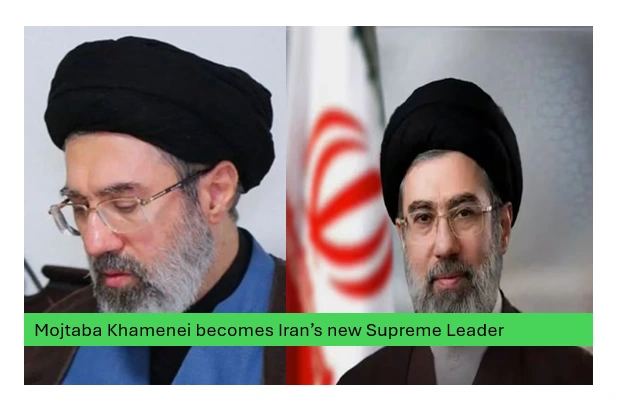
The Islamic Republic of Iran officially announced Mojtaba Khamenei as its third Supreme Leader in a move that has made the minarets of Qom to shake the corridors of the white house. The ruling, issued late on Monday, March 9, 2026, is the biggest-and-most-debatable political change in the history of the country since the 1979 Revolution.
The appointment arrives during one of the mournings and existential perils that the country had never faced before. Since Ayatollah Ali Khamenei, among the founders of their Islamic revolution, was killed by the joint U.S.-Israeli airstrike on February 28, the country has been engaged in a high intensity game that has seen its power grid brought to its knees and its leadership decapitated. The naming of the 56-year-old Mojtaba by the Assembly of Experts has been a course of orthodox continuity, which is sending a message to the globe that the sacred system will not be compromised, despite being burnt.
The Prince in the Shadows gets out of the Shadow
Mojtaba Khamenei was the man in the shadows during decades. Contrary to his father, he never preached a Friday sermon at the Tehran Friday Prayer; contrary to the presidents whom he assisted in his administration, he never contested an election. Rather, he was the silent mastermind behind the office of his father, creating a potent power base inside the Islamic Revolutionary Guard Corps (IRGC) as well as the intelligence service.
The rise to power by him comes as a historical irony to many Iranians. The revolution that overthrew the Pahlavi monarchy was constructed on the basis of renouncing the hereditary rule. At this moment the “Velayat-e Faqih” (Guardianship of the Jurist) has been bequeathed father to son.
It is a silence of the streets of Tehran today, heavy, and I am saying this conditionally and anonymously through an encrypted satellite connection. We were informed that this system was not a family system but a people system and a God system. But as the bombs drop people are too exhausted to dispute. They simply wish to know whether this new leader can end the war or he will lead to further wars.
Read also: Iran’s Busiest Mehrabad Airport Comes Under Attack
An election in wartime under fire
The way Mojtaba was chosen was not normal. A group of senior clerics known as the Assembly of Experts, which comprised 88 senior clerics, was reportedly having their deliberations secretly and virtually after being targeted by an Israeli attack last week on their headquarters in Qom. Leaked reports have it that the IRGC used maximum pressure on the clerics to seal the deal on the appointment of the cleric saying that it was an invitation to complete destruction that there was no leadership to lead in a war being fought by an armed nuclear-capable superpower.
The decisive vote was declared soon after the new strikes were reported at oil stores in the capital suburbs. Mojtaba was a learned scholar, and a faithful defender of the revolution, in the formal proclamation of the Assembly, and urged all the Iranians to swear their fidelity to the new Leader (Bay’ah).
Read also: India Finally Condoles Khamenei’s Death
The International Response: A Choking Necklace
The global response was fast and duly divisive. President Donald Trump did not take long to dismiss the new leader in Washington. On Sunday, the President made a speech to the reporters dubbing Mojtaba an unacceptable candidate and a lightweight.
Trump threatened to fire him unless we give him the permission. We desire a leader who desires peace as opposed to the one who desires to perpetuate the terror reign.
In Israel, it was even more business-like. The IDF also put a terrifying message in Persian on a social media, saying that the hand of the State of Israel would keep on hunting down anyone who wishes to keep the aggression of the current regime. The unspoken threat a Mojtaba is now targetable by legal military means has pushed the new Supreme Leader into an undisclosed bunker where his first days of rule have been literally an underground exercise.
On the contrary, regional partners such as the Houistas in Yemen and remnants of the Hezbollah celebrated the choice as a crushing to the foes of the country. Mojtaba to them is the continuation of the line of resistance.
