


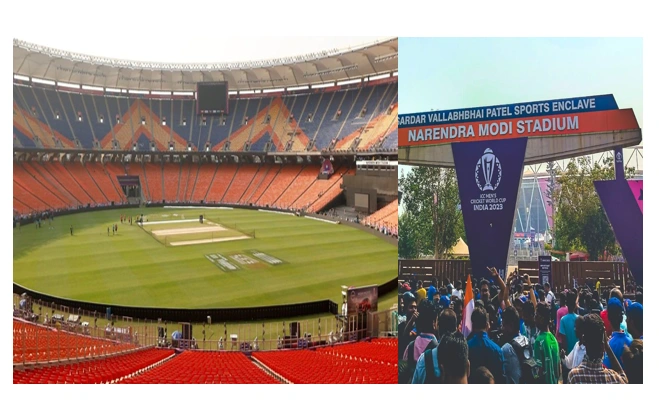
With the world on the verge of the high-octane T20 world cup final on Sunday, March 8, it is not only all about the titans, which are India and New Zealand, but also about the stage. The Narendra Modi stadium in Ahmedabad, an expansive giant that accommodates 132,000 screaming spectators is not just a mere scenery. It is a breathing living being in the game itself.
To captains Suryakumar Yadav and Mitchell Santner, it is a tactical maze. The unique conditions in Ahmedabad are not merely some buzzwords but variables that can make a world-class opener a tentative defender or a medium-pacer a match-winner.
The Soil Secret: Red vs. Black
Contrary to conventional grounds, Ahmedabad is a unique multilingual ground with 11 center pitches and having two types of soil. The DNA of the match will depend upon the strip chosen on which the final will be made.
- The Black Soil Paradise: As it is traditionally known, the black soil pitches at Motera are a dream of a batter. They have less bouncing since they hold on to moisture longer and provide a more reliable and flatter bounce. When the final is on black soil, it will be a run-feast with the 200-run mark under siege all the time. Power-hitters such as Finn Allen and Sanju Samson will be convinced that they are at home because they can rely on speed to drive through the line.
- The Red Soil Trap: In case there is a choice of red-soil surface by the curators, the game acquires its 180-degree twist. Red soil is very likely to dry and crack in the hot Gujarati heat, and provides a lot of grip and turn. This would introduce players such as Varun Chakaravarthy and Santner into the game at an early stage which would turn a high scoring shootout into a tough, witty battle.
Read also: T20 World Cup 2026: India, England ready for shootout at Wankhede
Cauldron of Shadowlessness and the White Light
The pure overload of senses is one of the humanizing factors of playing at the Narendra Modi Stadium. Towering floodlight masts are used in traditional grounds whereas Ahmedabad has an inbuilt LED ring light system on the roof.
The design has eradicated shadows in the field which the players say makes them feel as they are playing in a glowing spaceship. There is, however, a special disadvantage to this innovation. The lights are also lower than conventional masts and this may cause spotting problems. The high-towering catch of a World Cup final can easily disappear in the white glare of the LED ring a second, the difference between a winning wicket and a disastrous drop.
The Invisible Protagonist: The Dew Factor
Once the temperatures in Ahmedabad fall below 8.00 PM, a silent participant comes into the arena: Dew. During a night game, the grass could be wetened within a short period of time because of the humidity caused by the adjacent river called the Sabarmati.
The ball gets like a bar of soap, and this was observed by one coach in the Super 8s.
Dreamy weather is a nightmare to the team of bowling at the second place. Spinners become unable to hold onto the seam, and fast bowers have difficulty with regards to releasing, and end up throwing a full-toss inadvertently. On the other hand, the wet grass is used as a lubricant and thus the ball slides on the bat with speed, which greatly benefits the chasing team. This renders the toss, which is normally a 50-50 toss, to be more of a 70-30 favor to the captain who wins the same and decides to bowl first.
