


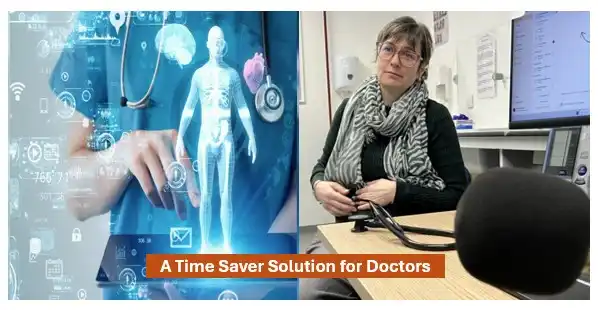
Scientists have recently developed an innovative AI-powered AVT, i.e., Ambient Voice Technology, to help general physicians/doctors record their patient consultations. UWE, i.e., the University of the West of England, experts in Bristol have developed this voice technology. It uses a special speech-to-text AI feature to record consultations, create important notes, and prepare letters for doctors to review later and approve.
Technology Allows More Face-to-Face Communication
UWE students have said that their newly launched voice-to-text AI technology is intended to improve patient care. It helps clinical staff be more involved in face-to-face communication with patients and no longer need to spend time writing notes.
Dr. John McCormick is the chief clinical officer at the South West of NHS England. He finds the new technology highly impressive and stated that the system will allow more eye contact between patients and clinical staff. In contrast, the staff does not need to waste time staring at the computer screen while entering the patients’ information.
Dr. McCormick is also a general practitioner in Devon. He mentioned that AVT is capturing the important bits, as it allows doctors to engage more and stay focused with their patients. Dr. John even said that the new technology will reduce the need to stay late to catch up on work. In particular, Dr. John and his fellow doctors/GPs had earlier been experiencing stress due to the extensive administration. However, the new AI-based solution has reduced the stress level.
also read:
- Why are users leaving ChatGPT?
- Google adds feature to help Android users track lost luggage
- Indian Man Builds World’s Smallest Battery-Powered Arcade Machine
Scientific Evaluation and Performance of the Ambient Voice Technology
General practitioners typically need 10 minutes per consultation. In contrast, scientists who have evaluated the innovative AI-powered speech-to-text technology have found that using AVT GPs need only three minutes per session. Accordingly, doctors have more time to analyze their patients’ conditions in depth. The outcome is based on the AVT test conducted on volunteer patients at the mock GP surgery at UWE.
Scientists at Health Tech Hub regularly evaluate diverse AI-based audio consultation models and their ability to handle various accents. The main objective of this evaluation is to deliver the best and most efficient AI-based solution to the NHS. However, doctors must analyze the final report to implement the proposed AI-based ambient voice technology to avoid or correct any mistakes.
Richard Luxton, the professor of bioscience and technology at UWE, said that even though AI technology may pose problems for broad accents, it can be trained to understand diverse voices. While working with UWE University, the RD&E, i.e., the Royal Devon & Exeter Hospital, has already adopted AI-based speech-to-text technology, becoming the first UK-based trust to do so.
The trust members have used the technology in about 6000 patient consultations since its launch in September. Now, the hospital claims it will roll out AVT to every outpatient clinic by the end of 2026, while the trust is exploring the technology to improve emergency care. Once the technology is rolled out in its full phase, it may create 15,000 appointments across the trust yearly.
Comments on the Application of AVT Powered by Artificial Intelligence
Paul Mitchel is the first patient of RD&E Hospital, who has undergone consultations via AVT. According to him, “During my whole appointment I got eye-to-eye contact of the clinician that made me feel comfortable and gave me a personalized experience, especially while hearing any difficult news.”
Later, the consultant gynecologist named Ben Peyton Jones commented, “I should thank to the innovative AI-based ambient voice technology, the new speech-to-text AI technology for our patients’ consultation. It helped me capturing even a few complex consultations with optimum accuracy and perfect documentation. Hence, I have saved my valuable time and paid more attention to my patients.”
