


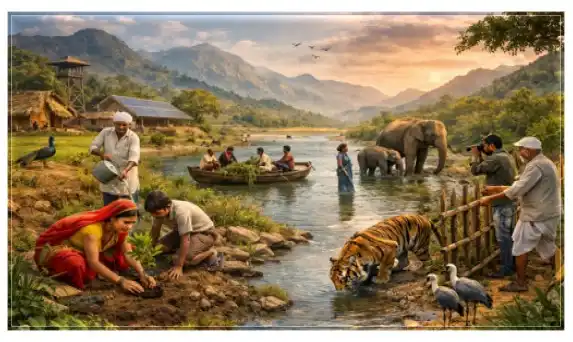
The history of the Indian environment had long been that of top-down management the lines that were drawn on maps by remote bureaucrats and fences that kept out outsiders. However, in the present 2026, a silent grassroots revolution has been taking back the message. The dry deserts of the Thar Desert, the foggy mountains of the Eastern Ghats, Indian villages are showing that it is not the ones with the highest authority but the ones with the strongest roots that can be considered the best guardians of the land.
This is not merely conservation in the scholarly definition of the term, this is a struggle to survive, a struggle to define who we are and to be allowed to co-exist with the wild.
The Hargila Army: How to make Omens Icons
The Greater Adjutant Stork or the Hargila, as the people of Assam call him, was a pariah in the villages. It was a scavenging pre-historic looking giant that everyone believed had been the harbinger of bad luck. When the tall trees in which the storks nest were cut down by villagers, it would get rid of the so-called curse.
Enter the “Hargila Army.” This movement, headed by conservationist, Purnima Devi Barman, has been able to mobilize more than 10,000 rural women to conserve these endangered birds. The Hargila is not a curse anymore, but a friend. The women also consider the storks as their extended families and hold the baby showers of the new hatchlings.
With their thread weaving of the bird to normal Gamosa textiles, these women have made a conservation crisis a booming local economy. The population of the storks in these villages is increasing at the fastest rate in decades in 2026 not due to ban by the government but because as the people of this village concluded that the survival of the bird could not exist without theirs.
read more:
- India’s Unique Backward-Flowing River
- Top 10 Best Cities to Live in 2026
- Unique facts about the five flower lake
The Faith as a Shield of the Orans of Rajasthan
Another type of resistance is occurring in the dry desert region of Thar in the heat of the day. The Bishnoi and other villages have preserved Orans, sacred groves, which are biodiversity oases, over generations. They are forests left untouched, where an axe is not allowed to fall on a tree, nor a hunter on a gazelle.
These sacred lands were endangered by a contemporary threat in the past years, gigantic renewable energy projects. Although the move towards green energy is crucial to the net-zero goal of India, the location of solar farms on the Oran land jeopardized the destruction of ancient ecosystems. It was in the landmark movement that began to pick up steam in early 2026 when more than 40 villages through their Gram Sabhas (village assemblies) made demands to have their groves legally protected.
They have an easy but far-reaching argument: You cannot take a living ecosystem down to construct a green machine. These villagers have been able to lobby through the traditional rights and the Forest rights act to have the Oran land of 900 acres handed over to the community back to community possession. Progress is not with them; they want a progress which honours the sacred.
Water Alchemists: Rebirth of Dying rivers
What happens when you go to the Alwar district of Rajasthan or the Ahmed Nagar area of Maharashtra is that these areas will not give you the impression of the desert since their scenery does not fit the description. This is what the Johad and the Check Dam have left.
Such villages as Ralegan Siddhi and Hiware Bazar have turned into world prototypes of water security. In this case the philosophy is catch the rain where it falls. Rather than relying on massive and costly canal projects, the villagers relied on an old masonry and collective effort to construct thousands of small earthen dams.
The effect is being felt in the reappearance of the wildlife. Dried-up springs started to run as the level of groundwater increased. The Arvari river that was a dry route over the decades is flowing all year long. The water came with the leopards, the hyenas and the migratory birds. The villagers have their own rules: no borewells, no water-consuming crops such as sugarcane, and a shared duty to preserve the woodland cover which nourishes the river.
