


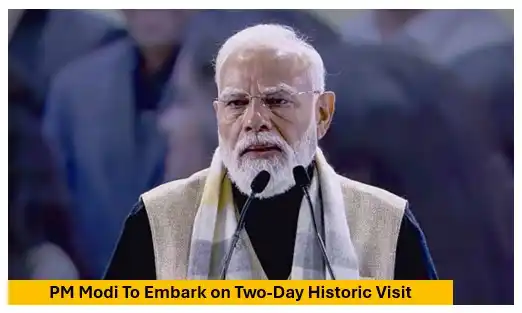
On the morning of February 25, 2026 as the sun rises over the Mediterranean, Air India One will land on the tarmac at Ben Gurion Airport — ushering in what many might call “Strategic Partnership 2.0.” Prime Minister Narendra Modi’s return to Israel is much more than a sequel to his groundbreaking visit in 2017; it is a high-stakes mission to solidify a bond that has quietly turned into one of the sturdiest in modern geopolitics.
That also included the iconic “beach walk” between PM Modi and Prime Minister Benjamin Netanyahu in 2017 — a picture that spoke volumes for a chemistry at the personal level. The 2026 visit, even in the current vexing and volatile West Asian landscape beset with global pressures, demonstrates a mature, multi-dimensional alliance.
A Global South for the Knesset Address
PM Modi’s address to the Knesset, Israel’s Parliament, is the crown jewel of day one. He will be the first Indian leader to stand at this podium — a gesture that Netanyahu has described as a “historic moment” for the Jewish state.
The speech is likely to be a gargantuan tightrope act. The Prime Minister is also likely to reiterate India’s role as the voice of the Global South, calling for a “rules-based international order” and stability in a region that is now on edge while reinforcing India’s commitment to its “Strategic Partner.”
“India and Israel share a meeting of the mind on the issue of scourge of terrorism,” Indian Ambassador J.P. Singh said. “This trip is based on a trust that has made us support each other in every crisis.”
“Mission Sudershan”: The Shifting Paradigm of Defense
Even as the public spotlight is all about speeches and ceremonies, the real “engine room” of this visit is Defense Cooperation. The two countries are going beyond the traditional buyer-seller relationship toward a model of joint development and co-production.
India’s grand plan to set up a multi-layered anti-ballistic missile defense shield — dubbed “Mission Sudershan” — is at the heart of these talks.
The aim: The Indian hinterland must be safeguarded against long-range threats.
The Tech: Building on Israel’s tested technology with Arrow, David’s Sling and Iron Dome.
Long-Term Significance: Joint production of advanced laser defense systems and long-range stand-off missiles.
Innovation And The “Hexagon of Alliances”
Prime Minister Netanyahu has frequently described an “hexagon of alliances” comprising India, Arab countries and Mediterranean partners. This visit serves as the impetus of IMEC (the India-Middle East-Europe Corridor), which has the potential to transform global trade patterns.
The two leaders will also attend a High-Tech Exhibition displaying startups that are addressing problems around the world.
Water Security: Desalination and drip-irrigation technologies are now changing the face of dry farm lands in Bundelkhand and Marathwada.
Health-Tech: Israeli companies develop, and Indian manufacturing scales, AI-powered diagnostic tools.
Remembering History at Yad Vashem
The next day will include a visit to Yad Vashem, the World Holocaust Remembrance Center in Jerusalem. This visit is highly symbolic, particularly as the Prime Minister will be presented with the “Book of Names,” a memorial that recounts millions of victims. In a world in which historical memory is often disputed, this visit reinforces India’s repudiation of hate and our common humanity with Israel.
In the meetings that follow with President Isaac Herzog, they will touch on the human face of the partnership — the 41,000-strong Indian diaspora and the almost 20,000 Indian workers to have recently entered into the Israeli workforce filling in for gaps both in construction as well as caregiving.
