


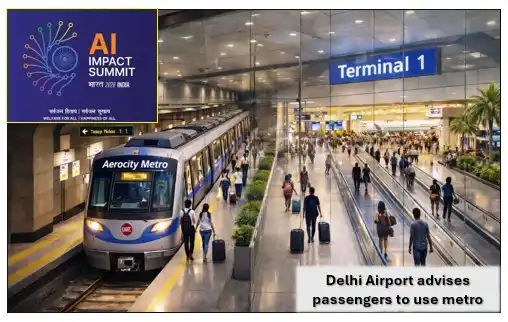
As New Delhi becomes the focal point of global technology this week, the Indira Gandhi International (IGI) Airport has released an important travel advisory for fliers. Celebrated India AI Impact Summit 2026 is all set to open its distinguished doors at Bharat Mandapam, the city awaits tourists across the globe along with international dignitaries and tech magnates for this event with a planned footfall of over 2.5 lakh people from various parts of the world.
So regular travelers don’t get stuck in the “algorithmic” region of Delhi’s street traffic, Delhi International Airport Limited (DIAL) has an obvious recommendation: Ride the Metro. The rearrangement has been planned to avoid the expected traffic snarls around the Pragati Maidan area and central Delhi, which are likely to be cordoned off with high security during VVIP movements from February 16 to 20.
Getting Around the Capital City: The Metro Edge
For the participants arriving at IGI, the airport authorities have cited Delhi Metro as the fastest and best “short-cut” to their destinations. If you are simply a traveling professional catching the meeting, or an Expo attendee our rail connections provide congestion-free ease to and from your chosen destination.
Route Recommendations from DIAL:
- For Terminal 1 (Domestic): Passengers are advised to use the Magenta Line. It also acts as a fast connecting route to South, Central and West Delhi through the interchange facilities available at Tis Hazari Interchange.
- Journey to the Summit How To Get There: If you’re headed for the summit itself at Bharat Mandapam, alight at Supreme Court Metro Station on the Blue Line. Passengers can take the Airport Express to New Delhi, then switch to the Yellow Line for one stop to Rajiv Chowk and connect to the Blue Line.
Why the Surge? The Scale of the AI Impact Summit
The advisory is more than a precaution—it reflects the sheer size of what happening at Bharat Mandapam. It is not your average tech conference; it is the first global AI summit to be held in the Global South and its logistical footprint is huge.
A 70,000-Square-Metre Showcase
There are 10 giant arenas in the India AI Impact Expo 2026. To oversee safety of world leaders as well as the multitudes attending, Delhi Police and central agencies have put in place a multi-tier security grid. This includes:
- VVIP Corridors Certain roads leading to the venue have been cordoned off for the delegates coming from different hotels, thus naturally reducing road space for public traffic.
- Security Checkpoints: Heightened surveillance at borders of New Delhi district will result in longer waits for private cars and taxis.
- The “Bharat Mandapam” Effect: Just like during G20, the vicinity of Pragati Maidan is the “Heart Zone”, where all roads have restricted access.
The Broader Implications: AI and Urban Transport
It is interesting that the top itself, the one transmitting the traffic, ironically is discussing to solve it out. A “Seven Chakras” on the summit — Resilience, Innovation and Efficiency will examine how AI can be used to make urban traffic flow smoother through public transportation systems. In the more distant future, we will have AI-enabled traffic management that won’t allow a crunch like this even to occur.
The “intelligence” for now is in selecting the Metro, though. If the national capital shows off India’s digital prowess, then the Delhi Metro could be seen as testament to physical infrastructure that helps keep a city going. Whether you’re part of the 12 native AI models being introduced or simply passing through, IGI’s message is plain: steer clear of the snarls, groove on the rails.
