


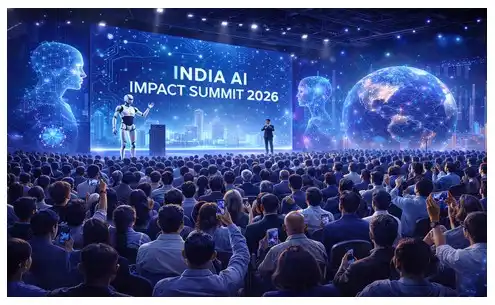
Next week, all eyes will be on New Delhi as the city gears up to host India-AI Impact Summit 2026. This is not just another tech conference; it’s an extraordinarily high-stakes diplomatic meeting marking a key turning point in global governance. The summit, which will be held from February 16 to 20 at the Bharat Mandapam, will witness a huge gathering of heads of state and giants in tech along with policy experts.
The most expensive industry gathering ever will be held in the Global South for the first time. This shift is intentional. Whereas earlier summits in London, Seoul and Paris stressed theoretical risks and security, India is driving a different agenda: impact. The aim is to shift from abstract discussions toward practical, inclusive implementation of AI that has the potential to transform people’s lives worldwide, whether in developed or developing countries.
A Power-Packed Guest List: Who’s Coming?
Around 20 world leaders are flying in to the capital, with ministerial-level delegations from more than 45 countries confirmed by the foreign ministry. That so many people are attending any level of AI discussion is a firm reminder that AI isn’t just a “tech issue,” it’s about national security, economic survival and sovereign identity.
High-Profile Heads of State
Emmanuel Macron (President of France): Coming on February 17, Macron is a major face to have at the event given that France has also been leading discussions around AI regulation. The two will hold discussions on the roadmap “Horizon 2047”, connecting artificial intelligence (AI) with India-France bilateral defense and space cooperation.
Luiz Inácio Lula da Silva (President of Brazil): Offering the view from the G20’s recent past and its future leadership, Lula will explore how AI can help close the inequality gap.
Sheikh Khaled bin Mohamed bin Zayed Al Nahyan (Crown Prince of Abu Dhabi): UAE’s participation serves as a testament to the increasing collaboration between New Delhi and Middle East in high performance computing and data centers.
European and regional in continental Leaders on the list range from prime ministers of the Netherland (Dick Schoof), Greece (Kyriakos Mitsotakis) and Finland (Petteri Orpo).Also in this category are regional relations including those around Sri Lanka’s Anura Kumara DissanayakeAnd Bhutan’s Tshering Tobgay.
The Silicon Valley “Avengers”
The summit is not all for politicians. The most powerful tech C.E.O.s in the world are supposed to be in the room, speaking for the companies that actually build the models. Names such as Sundar Pichai (Google), Sam Altman (OpenAI), Jensen Huang (Nvidia) and Dario Amodei (Anthropic) will join in discussion with Indian industry giants Mukesh Ambani, most valuable player of the recently concluded first phase of the English Premier League auction, three other famous punters from Diwali Bollywood blockbuster makers producers banner Suraj Bharjatiya, Yash Chopra who Sadak installed chairman Rakesh Sippy.
Why This Summit Is Different Than the Others?
At the UK-based Bletchley Park summit, “Existential Risk”—the idea of a rogue AI—has come to monopolize the global conversation. Though it accepts these risks, the New Delhi Summit will make a dynamic shift towards “Diffusion.”
The larger concern revolves around “diffusion” — how quickly and evenly AI gets spread to a population. If only the top 1 percent of countries have AI, the digital divide will grow into an insurmountable chasm. Pooling 20 world leaders, India is trying to build a Multilateral Mechanism for AI Deployment.
Rather than waiting for a “Global AI Treaty” (which is decades away) this summit seeks to produce a “New Delhi Compendium”—a compilation of real-world applications where AI is already at work in agriculture, energy and public service delivery.
Looking Ahead: The “Impact” Era
The India-AI Impact Summit is where the global technology hierarchy has started to re-order itself. For decades, we in the Global South were viewed as data input or software market; even when so-called trusted partners established us, they sounded like their needs first. Next week, New Delhi will make the case that it is in the Global South where we can expect to see the most significant “impact” of AI.
If it works, the summit will solidify India’s position as a “bridge” between tech-driven Global North and resource-hungry Global South. It is a bold bet on the notion that the future of AI isn’t only about which company has the best algorithms, but also about who holds access to lots of data and the machines to turn it into answers.
