


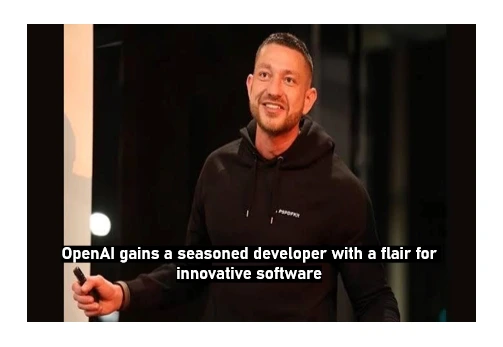
Peter Steinberger, an Austrian software developer known for creating the viral open-source Artificial Intelligence agent OpenClaw, has joined OpenAI to assist in shaping future generations of personal AIs, as announced by OpenAI on Sunday.
Sam Altman, CEO of OpenAI, posted on X (formerly Twitter) that Steinberger will be helping to lead the development of the “next generation of personal agents,” intelligent systems that can both interact conversationally with users as well as perform tasks for them in the physical world.
From Viral Side Project to AI Leader
OpenClaw was launched in November of 2025 and was formerly known as Clawdbot and Moltbot. It became popular due to its unique ability to perform tasks autonomously by interacting with multiple applications, such as clearing users’ email inboxes, managing their insurance, checking them in for flights, and booking reservations via messaging apps. Within hours of its release, OpenClaw received over 100,000 stars on GitHub and received millions of visitors to the website.
Steinberger’s work with OpenClaw has drawn the attention of developers and users alike because his efforts were to demonstrate ways that personal agents can integrate conversational AI with practical execution of tasks and help to simplify one’s digital life.
A Strategic Move for OpenAI
OpenAI’s decision to hire Steinberger follows the strong growth of competitive pressures in the AI space with particular emphasis on autonomous capabilities beyond the traditional chat interface. Altman noted Steinberger’s expertise will also help contribute to OpenAI’s larger goals around incorporating more agent-like behavior into their products.
Industry experts believe this hire signals that OpenAI is putting an emphasis on establishing multi-agent systems – or ecosystems of specialized, collaborative AI assistants – as one of their core future focuses. Analysts point out that creating agents capable of performing tasks without human involvement would be a significant step forward for AI.
OpenClaw as an Open Source Foundation
While Steinberger is joining OpenAI, the OpenClaw project will remain an independent open source foundation that will be supported by OpenAI. Altman confirmed that the community-driven spirit of the OpenClaw software will continue and that development resources will remain available for ongoing development.
In his blog post announcing his decision, Steinberger stated that continuing the open-source character of OpenClaw was a key priority for him. He felt partnering with OpenAI was the best way to scale up his vision of having advanced agents available to a larger audience.
Developer’s Vision: Impact Over Company Building
As previously stated by Steinberger, founder of PSPDFKit, which is a document-processing toolkit used by many; his main goal isn’t to create a large commercial company around OpenClaw, but rather to help change the world by creating AI assistants that can be used for everyday tasks. He feels this philosophy matches with his choice to embed OpenClaw inside an open-source foundation and work with a major AI lab instead of following the traditional route of growing a startup.
Through OpenAI, his work should help to redefine AI agents by making them act safely, intelligently and at a large scale. The rapid rise of OpenClaw has not been without controversy, however. Security experts have raised concerns about the potential for AI agents with full access to user systems and third-party accounts if they are misconfigured, as has China’s Ministry of Industry.
These discussions reveal an ongoing issue for autonomous AIs: Balancing the need for advanced automation while having reliable safeguards to prevent misuse and exposure of sensitive data. Both Steinberger and OpenAI are committed to ensuring safety will continue to be a primary component of their future design.
What’s Next for AI Agents?
One of the clearest examples recently of the shift in talent within AI is Steinberger’s relocation. This reflects the rise of autonomous agents and the increasing role they play in both research and consumer applications. In a world where AI labs and start-ups are creating new forms of innovation beyond the conversational bot, the emergence of task-oriented assistants could dramatically influence the future of AI applications to assist users; from personal productivity to automating corporate enterprises
At this point, only time will tell if these assistants will be commonplace tools or if they will face regulation, but Steinberger’s work with OpenAI has created significant momentum in this evolving field.
