


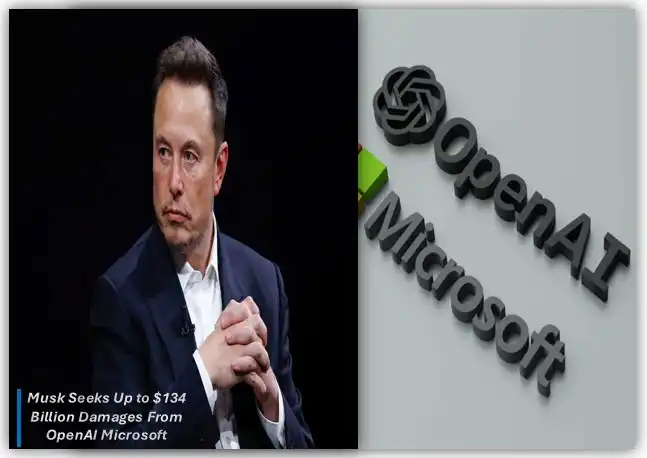
In a development that will redefine the size of high-tech litigation, Elon Musk has officially submitted a claim for damages ranging from $79 billion to$134 billion against OpenAI and Microsoft. The filing, filed January 16, 2026, is a gamechanger in an acrimonious dispute that started as academic quibbling over “mission creep,” and has morphed into high-stakes faceoff over the potential ultimate value of Artificial General Intelligence (AGI).
That number isn’t arbitrary, though; it’s Musk’s calculation of the “unjust enrichment” he alleges the two companies have collected by spinning out from a nonprofit research lab into a behemoth business.
Why $134 Billion? The Logic Behind the Number
At the core of Musk’s claim, according to his attorneys, are allegations that he was OpenAI’s chief architect and financier during its early days. His attorneys believe that, as one of the prime movers in OpenAI, Musk already can lay claim to a large piece of the company’s current valuation at $500 billion and growing.
The math is the work of financial economist C. Paul Wazzan who broke down the damages into two buckets:
- OpenAI’s “Wrongful Gains”: $65.5 billion to $109.4 billion, according to an estimate.
- Microsoft’s “Illegal Gains”: Ranging from $13.3 billion to $25.1 billion, according to court filings.
The filing likens Musk’s position to that of an initial seed investor in a high-growth startup. Musk contends that although he merely \”the donated\” approximately $38 million during 2015-2018, it was his seed capital — to say nothing of his street cred, recruiting and technical advisement — that ultimately constituted the hundreds of billions in value OpenAI (and now Microsoft) is “hoarding” behind a for-profit wall.
The Fraud Claim: “Moral High Ground” and Commercial Pivot
The lawsuit turns on the argument that Musk was duped into endorsing a non-profit mission that the other founders never meant to maintain. Musk’s representatives argue that internal discovery documents, including private diary entries from OpenAI co-founder Greg Brockman, reveal that a for-profit transition had been under discussions as early as 2017 — even while the founders were telling Musk personally that they would keep the organization “a philanthropic endeavor.”
One particularly damning excerpt from Brockman’s journal reportedly says: ”I can’t say that we’re committed to the non-profit … if three months later we’re doing b-corp then it was a lie.
Musk’s fundamental complaint is that OpenAI was conceived as a kind of “open source” alternative to Google. He famously declared in a tweet on 2023 that the company had become a “closed-source, maximum-profit company entirely under Microsoft’s control.” By seeking those damages, Mr. Musk is effectively asking the court to “disgorge” the profits that he says were earned on the basis of deceit.
OpenAI and Microsoft Strike Back: “A Repeated Pattern of Harassment”
OpenAI didn’t take these accusations sitting down. In an acerbic statement, the company called the $134 billion request “unserious” and part of a “deliberate, attention-grabbing” campaign to hamstring a business rival.
The defense posture of OpenAI revolves around 3 key aspects:
- Musk’s Approval: The company alleges that Musk himself suggested some of the for-profit plans the board OK’d back in 2017, after knowing his venture would require huge infusions of cash — and under a for-profit setup he proposed and where he’d have retained majority stakes and merged the business with Tesla.
- No ‘Betrayal’: They contend that the reorganization into a Public Benefit Corporation (PBC) was the only means of raising billions in capital necessary to remain competitive with behemoths like Google and Meta.
- Conflict of Interest: OpenAI has noted that Musk is a competitor now, with his AI project xAI and has suggested this lawsuit as an attempt to get competitive advantage by understanding the proprietary techniques or ruining their alliance with Microsoft.
Microsoft has said little in response, but filed a separate motion attacking the validity of the damages calculation and calling its economist’s analysis “unverifiable” and “unprecedented.”
What Happen Next: The Road to Oakland
As a legal drama, this one is chugging along toward a full jury trial — set to open now in late April 2026 in Oakland. Last year, Federal Judge Rebecca Haywood paved the way for the trial by denying most of OpenAI and Microsoft’s motions for summary judgment.
The trial is to include a “who’s who” of Silicon Valley witnesses, including Sam Altman and Ilya Sutskever, as well as possibly Microsoft CEO Satya Nadella. Jurors will need to determine whether a charitable donation to a non-profit can allow such funding to be recharacterized as an investment should the organization later radically shift its core nature.
Key Implications of the Case:
- Non-Profit Ethics: If Musk wins, it opens the door to a huge legal precedent about what non-profit organizations can (or can’t) do when transitioning into for-profit status.
- The Valuation Gap: Should the court determine that Musk deserves a stake in proportion to OpenAI’s valuation, it could go a long way toward wrecking OpenAI’s chances of ever raising more funding or going public.
- The AI Arms Race: The lawsuit is a major headache for OpenAI — at the very moment it’s trying to reach AGI milestones and become more closely integrated with Microsoft’s “Stargate” supercomputing effort.
As the lawsuits heat up, one thing is for sure: the endgame in this lawsuit will determine how corporate structure and “moral ownership” of the AI revolution should take shape over generations.
