


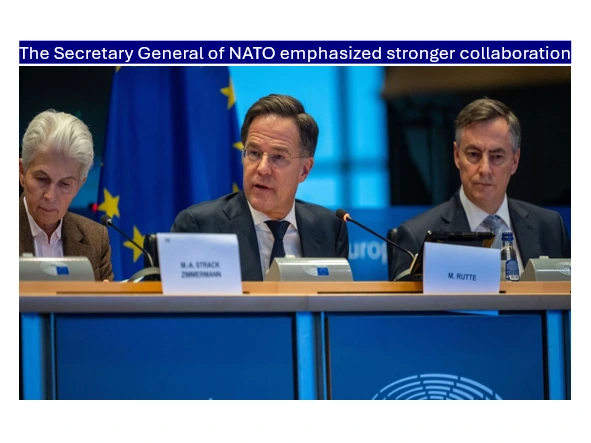
It was almost palpable in the hallowed halls of NATO headquarters here, where the air felt different yesterday. Now, on 12 February 2026, after crunch meetings of Allied Defence Ministers, Secretary General Mark Rutte took to the platform in front of his Press Corps not merely to provide an update, more to make pronouncements about what he declared a “fundamental shift in mindset.”
For many years NATO was derided as a “talk shop” where the European nations relied on the United States security umbrella more than they were willing to pay for it. But amid preparations for the 32-member Alliance’s landmark Ankara Summit this July, that dynamic has been irrevocably shattered — and in its place is emerging a far more self-confident, urgent and cohesive European defense pillar.
From Complacency to “Wartime” Ownership
Secretary General Rutte, who assumed the position in late 2024, said he had not recognized the debates this week — they were nothing like those that he has sat in on since 2010. The move is not just a matter of spreadsheets and budget lines; it’s a shared psychological acknowledgment that the age of the peace dividend has ended, officially.
The 5% GDP Commitment
The most mind-blowing evidence of this new mentality is the momentum behind the 5% GDP defense spending proposal. When it was introduced in 2014, the now-paltry sounding target of 2% looked like an ambitious ceiling; but at the Summit in The Hague in 2025, that went out the window with nobody so much as batting an eyelid at a remarkable 5% by 2035.
The German Example Rutte pointed to how Germany has changed, saying that Berlin was planning to spend €152 billion ($180 billion) by 2029—double its budget in 2021.
Innovation and Industrial Mobilization
In the words of the Secretary General, more money is pointless without capacity to produce. To satisfy this demand, the Alliance is transitioning to a “wartime industrial footing.
The ‘Deep Strike’ and Drone Revolution
Aside the ministerial meeting, several pioneering multinational initiatives were launched:
- Smart Precision Deep Strike by Drone: Denmark, Lithuania, the Netherlands, Poland and Türkiye have agreed to co-operate on the next generation drone technologies.
- Integrated Air and Missile Defence (IAMD): Seven Allies are jointly contributing to the development of next generation interceptor missiles and sensors with the UK, France, Türkiye and others for ballistic threat defence.
- The Ukraine Lesson: Rutte extolled that country’s “remarkable cleverness” on the battlefield, which he said meant our partners in NATO have been forced to pay for weapon systems taken directly from Ukrainian designs.
10 Pillars of the New Allied Deterrence
So let’s recap the “shift in mindset” trumpeted by the Secretary General: Here are ten key developments that will determine NATO’s path in 2026:
- The 5% Goal: Raising the target for national defense spending from 2% to 5% of GDP, including increasing investment in modernizing cars and planes, is necessary to restore our strength and readiness.
- European Leadership: The concept of Europe and Canada “owning” conventional territorial defense.
- Arctic Command: The so called Arctic Sentry to orchestrate High North security against Russia and China is on the horizon.
- Drone Interoperability: Quickly adapting lessons from the Ukraine conflict into NATO SOPs.
- Supply Chain Resilience –Building more robust supply lines within the Alliance, with a readiness of ammunition and parts that are “always ready.”
- Multinational Pooling: Allies pooling resources on expensive projects, such as ballistic missile defense, for efficiency.
- Long-Term Aid for Ukraine: Ensuring that 99 percent of aid to Ukraine is part of a joint NATO effort.
- Industrial Scale: Partnering with traditional and non-traditional defense industry to “turbocharge” production.
- Deterrence by Denial: A flip from “escalation dominance” to making aggression against Allied territory physically and economically unfeasible.
- Political Unity: Political unity behind the common”unity of vision” on the “CRINK” (China, Russia, Iran, North Korea) alignment despite democratic differences among internal system members.
The Road to Ankara
And as the ministers leave Brussels, everyone’s focus shifts to the Ankara Summit in July 2026. The summit is set to formalize the most ambitious defense plans since the Cold War. For Rutte this “change of mindset” is the precondition for any success with these plans.
The message to everyone, and to potential adversaries, is clear: it’s no longer business as usual for the Alliance — we are shaping our posture instead of just managing it. In a world that’s neither in peace nor at war, NATO has opted to prepare for both.
