


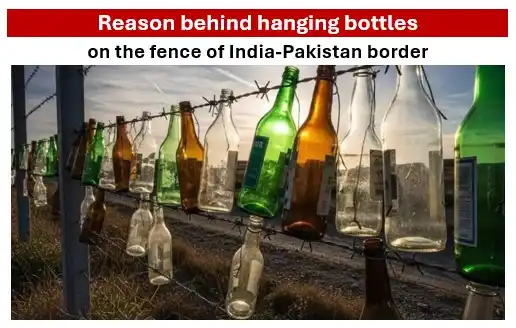
Many observers have noted that there are a number of plastic bottles tied or hanging from the barbed wire sections of the India-Pakistan border in particular in the area of Punjab along certain sections. This is not unusual because this is related to practical border management and local conditions but it is not a form of symbolizing or protesting anything.
Low-Cost Wind Indicator
A primary purpose of the bottles hanging on the fence or attached to it is to be used as an inexpensive wind indicator.
Winds are often prevalent along the border, especially when high winds cross over the open agricultural fields. As the wind speed rises, the bottles will move back and forth as they are swinging on the fence or bouncing against each other. This movement provides security personnel the opportunity to:
- Determine by sight what direction wind is blowing and how strong the wind is blowing (intensity level of the wind)
- Observe how the weather is changing on the ground
- Be aware of unusual disturbances occurring in the vicinity of the fence
As a result, in sensitive border areas any small physical indicator can help ensure that military personnel remain alert to observe unusual activities taking place near the fence.
Indication of Disturbance Near the Fence
In addition to being a low-cost wind indicator, the bottles can also be used as a basic disturbance indicator.
As a result, if someone tries to cross the fence or tamper with it, that action will move the bottles, thereby making noise. During night patrols, or during periods of low visibility (such as nighttime fog, which is quite common during the winter months throughout the state of Punjab), this increased motion/noise will help to alert BSF (Border Security Force) personnel.
Many sectors use advanced surveillance equipment such as floodlights, thermal imaging cameras, and motion detectors; simple physical indicators can also help provide an additional level of support and security.
Read more:
- Which Country Has the Most Mountains in the World
- Unique facts about the five flower lake
- India’s Unique Backward-Flowing River
Preventing Damage and Sagging of wire
In some locations, fence sections that use barbed wire and concertina wire are tied to bottle sections to control both wire tension and spacing within the barbed or concertina wire.
Border fences run long distances and are subject to:
- Summer’s extreme heat
- Winter’s heavy fog
- High winds and storms
Using plastic bottles can help maintain distance between the coils of wire, and can also help prevent entanglement of the wires. While bottles are not considered a primary structural component, they may assist in relatively minor maintenance to borders.
- Deterring Animals from Fences
- Along the U.S. / Mexico Border, the border runs through very large areas of land used for agricultural purposes. At times, animals will travel across the border; therefore, items that hang from fences moving with the wind will:
- Discourage cattle from leaning against the fence
- Help animals from accidentally damaging the fence
- Help reduce the amount of maintenance performed on the fence
- Moving and making noise from an item attached to the fence are simple deterrents for animals on open range.
Not a Political Symbol
To date, no verifiable proof exists to substantiate any political messages, covert signals or activist symbols attributed to the use of bottles on the border. Bottles are primarily used as practical solutions for the management of border security within specific areas.
Border security infrastructure often relies on ad-hoc, locally-sourced solutions tailored for the specific terrain or climate conditions. Therefore, things that might look strange to someone visiting (like hanging bottles) can sometimes become more relevant or important to standard operating procedures after you see them in real time.
When you look at the India/Pakistan border, it is one of the most heavily patrolled borders on the planet. Some of the physical elements of border security include:
- Multi-layered (i.e., double) perimeter fencing
- Floodlights for nighttime visibility
- Watchtowers along the length of the perimeter fence, to identify intrusions into the security zone, provide information about border security, and support operations at early morning hours
- Electronic security, such as CCTV systems that identify unauthorized movement/conduct along the border, which are monitored 24/7
- Regular patrols of armed security forces throughout the day and night.
In such an ultra-secure environment, even small modifications to perimeter fencing are critical in terms of tactical advantage.
In conclusion, the hanging bottles supported by the fence along the India/Pakistan border are largely functional to help identify wind patterns, identify disturbances, deter animals, and assist with maintenance of the fence.
While they may seem to be visually interesting at first, it illustrates how simple and inexpensive solutions are sometimes incorporated into advanced border security systems in highly sensitive border areas.
