


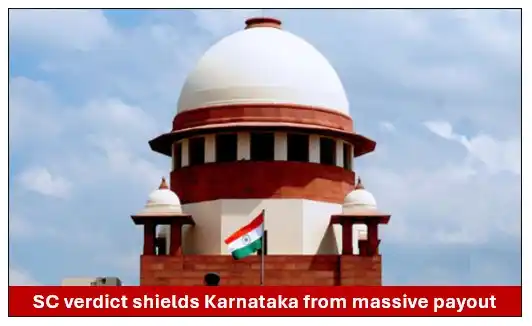
Delhi High court has granted interim relief to the government of Karnataka – in one of the landmark legal victories, which have wide-ranging repercussions for public finance. On February 9, 2026, the apex court had paved the way for challenging of what it termed as “excessive and questionable” compensation awards for acquisition of land under some key irrigation and infrastructure projects in the state.
The Reference Court Problem
Refusing to accept the compensation decided by Land Acquisition Officers (LAOs), many land-holders moved Reference Courts for enhancement. In hundreds of instances, those courts won hefty increases — payouts that the state contended were inflated and didn’t accurately reflect both real market values as well as government guidance values.
The Supreme Court’s “Pragmatic” Intervention
This is no longer the case thanks to theSupreme Court decision. The bench held thatHigh Courts must adopt a “pragmatic” rather than a “pedantic” attitude in dealing with such delays
You may also like:
- Supreme Court’s statement to Whatsapp
- TMC welcomes Supreme court to intervene in SIR cases
- Supreme Court to WhatsApp
Uncovering the ”Lax”Daisical System: Warning on Collusion
Perhaps one of the judgement’s most humanized and salient features is the kicking Court gave to how state departments operate internally. The bench didn’t just consider the law; it considered the people who existed beyond the paperwork.
The court said the delay in filing of 530 appeals was a “classic case” of slowing pace. In most of the cases, government officers had not even applied for certified copies of judgments in the Reference Court in time.
“Accountability is an essential requirement in a constitutional democracy… When the instrumentality of State and its functionaries weaponise such connivance and collusion as demonstrated in this case, it’s a sure recipe for undermining public confidence.”
The state government has itself raised the spectre of a “serious and systematic collusion” involving some officials together with advocates, delaying appeals to ensure that excessive awards of compensation finally went through. Karnataka has already formed a high-level inquiry committee to fix responsibility on erring officers.
Aid for Development: Economic Assistance / Types of Aid Financial Relief A Fillip to Industry.
The stakes, financial and otherwise, of this verdict cannot be overstated. For a state juggling ambitious welfare programs (such as its five “guarantee” schemes) with enormous infrastructure deficits, a tens of thousands of crores payout would have been crippling.
Collaborative governance and enforcement Given the inherent difficulties of law enforcement and litigation in China, an additional way to promote the integrity in rural land deals is ‘collaborative governance’, which involves self-regulation by actors involved in disputes, mutual monitoring between regulatory authorities at different levels.
The verdict is a huge win for the government but also an illustration of the fine balance in land acquisition. “Fair compensation” is the objective of this 2013 Act, but the Supreme Court has already made clear that “fair” is not synonymous with “excessive due to procedureior error.”
For the thousands of other farmers implicated, the fight now returns to the High Court, where their claims for compensation will be argued on their merits. For, as far as the Karnataka government is concerned, the diktat must be they overhaul the “lackadaisical” mechanism, enforce accountability and guard the public purse with an even greater ferocity than that with which it acquires land.
