


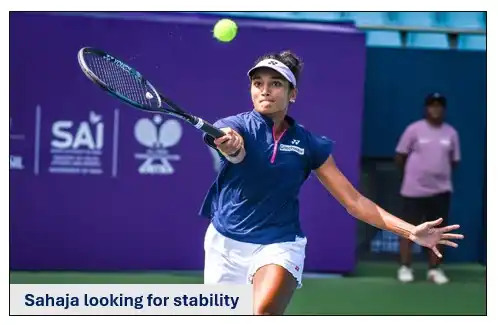
In professional tennis, the path to the top can be as dependent on what happens off the court as it is on those baseline rallies. For India’s current women’s singles No. 1, Sahaja Yamalapalli, the 2026 season has begun with one thing in mind: steadiness. Following years of a carousel in her coaching staff, Sahaja has pair with a new coach, Petr Kuchlikov, with the intention to offer the tactical and emotional reference point she needs to break through into Grand Slam qualifying ranges.
From Hyderabad, the 25-year-old suffered a “start-stop” journey familiar to many Indian athletes—brilliant but frustrating spurts of individual talent which have too frequently been prevented from blossoming properly in the long term by an absence of steady technical direction.
The Missing Piece: Stability is What Matters?
Sahaja’s journey to the top of Indian rankings was more of a lone struggle, with intermittent “on-and-off” coaching support. Although she reached a career-high ranking of 284 in the end of 2024, she vowed in early 2026 that her future is being “blocked” by not having consistency.
It was just back and forth with a coach, without a coach — I feel like that hurt me a little bit,” Sahaja reflected at a recent tournament in Thailand. Jow more than a coach is an objective mirror in Tennis. With no one watching all the time, little techno-glitches — the hitch in a serve, your head on clay defenselessly receding within its shell — can go uncorrected for months. In bringing on Petr Kuchlikov, Sahaja is looking for someone to grow with her “week after week” — not just fix things up in a preseason camp.
Read also:
- Who are the highest wicket takers in T20 World Cup?
- Vaibhav Suryavanshi Breaks U19 World Cup Records
- Why Axar Patel remains India’s unsung MVP
The Road to 400 and Back: Present Form
The beginning of 2026 has included a lot of good with some bad, the kind of results that helped necessitate this coaching change. Ranked somewhere around 428, Sahaja has hinted at being back to her best – she reached the quraterfinals of an ITF W75 in Nonthaburi after grinding out a three set victory over top-250 player Chloe Paquet.
A first-round loss in the Mumbai Open 125 at the hands of Japan’s Eri Shimizu (7-5, 6-2) earned her a reality check. In that match, Sahaja played a brave first set but appeared to lose the tactical thread in an increasingly tight contest in the second — precisely the “match-flow” problem Kuchilikov is charged with solving.
Conclusion: A Season of Growth
The “Sahaja-Kuchlikov” era is still in its honeymoon, but the message has been sent. This is not only about winning a handful of matches in Pune or Mumbai; it’s about mounting a defensive structure that can hold its own amid the stresses of putting on a global tour. While Sahaja heads to the spring season, the tennis world will wait and watch if this stability, Sahaja has found in her personal life can reflect on what she is chasing for a long time since turning pro.
With a steady coach, a keen mind for nutrition and a thirst to play for India on the brightest stages, Sahaja Yamalapalli is finally giving herself the support system her talent deserves.
