


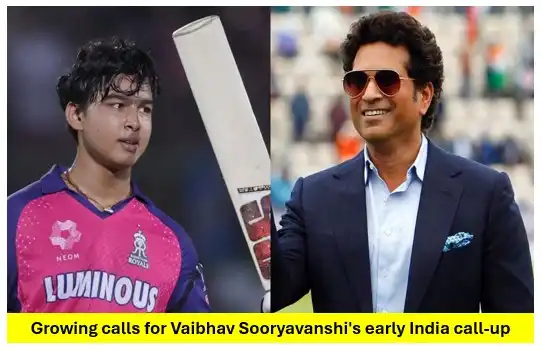
There is nothing new to the “prodigy” narrative in Indian cricket. From the dusty maidens of Mumbai to the high-tech academies of Bangalore, talent-spotting for the next generational wonder is a national sport. Vaibhav Sooryavanshi, though is one such name that has become a point of heated debate. At the tender age of 13 (as per official records), the Bihar-born opener has turned talk from “one for the future” to “why not now?”
While the clamour to rush him into the national setup gets louder, the ghost of 1989 is never far away. The prevailing view of fans and even a fellow cricketer is one that is basic yet incendiary: if Sachin Tendulkar was not kept waiting, how can we wait for Vaibhav?
The Stat Explosion: Why the Hype is Real
To appreciate what all the Sooryavanshi fuss is about, you have to look past the age and into the brazenness of his scoring. This isn’t one of those situations a lot of kids find themselves in when they crush their mates: this is a young man pulling apart professional standard bowling attacks with the disdain of a seasoned champion.
His recent exploits in the Under-19 youth Test versus Australia — that included a ton off just 58 balls — was a wake-up call. Not just the number of runs, but the speed at which he scored them and the range of strokes he played dumbfounded observers. Then when you see a 13-year-old pulling 140kph bouncers with a horizontal bat, running down the track to world-class spinners and the “age” argument feels like an arbitrary barrier.
(Special-in the history of Sooryavanshi rise to becoming).Key Milestones in the Rise of Sooryavanshi:
Ranji Trophy debut: One of the youngest to have played in India’s premier domestic competition.
Youth Test dominance: Fastest U-19 Test hundred by an Indian
IPL Auction Buzz: Age-wise the youngest player to have ever been sold at IPL auction, picked up by Rajasthan Royals.
The Tendulkar Parallel: A Two-Edged Sword
The comparison to Sachin Tendulkar is the ultimate accolade in Indian cricket, but also a crushing burden. Sachin was just 16 when he faced an attack from a menacing Pakistani pace battery in 1989 but at that time, the gamble was enormous. And it worked, because as well as being a tactical genius, Sachin was the other thing: unusually strong mentally.
Advocates for an early promotion of Sooryavanshi are all we want to say is if the talent calls for it, age should be just a number. They believe that, by the time he returns home, his game will have developed in a way that would have been impossible in India so early on in his career, just as it did for the Little Master.
The “humans” side of this argument, however, is fraught with fear. The world of cricket in 2026 is very different from that of 1989. The glare of social media, the non-stop diet of three formats and IPL slog as well the demands made by modern fitness on a 13-year-old body and mind are unparallelled. Is it fair to expect a teenager to bear the dreams of 1.4 billion people before he has even graduated from middle school?
Conclusion: A Generational Crossroads
The debate about Sooryavanshi is ultimately a debate over the philosophy of Indian cricket. Are we a system that waits for “readiness,” or are we a system that sees “greatness” and lets it fly?
If he is the heir to the throne, his journey will be among the most scrutinized in sport. Whether he makes his debut 14, 15 or 18 years of age, however, the feeling is unanimous: we are watching something special. The onus on the selectors then, is to ensure that by the time he dons an India cap, he’s not just a boy wonder but a man ready to go out in the world and conquer it.
The fans are restive, the talent is unquestioned and the shadow of Tendulkar looms long. So for now, what’s best for Vaibhav may be to let him play and fail and learn his way toward an understanding of how the world works — even if we have to watch through our fingers in anxious anticipation.
