


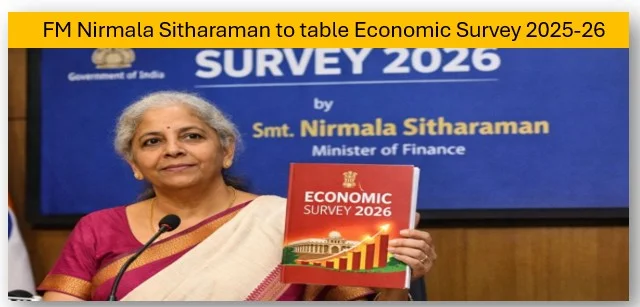
As the winter sun began to lower over the capital on Thursday, January 29, 2026, there was a certain crackle that filled the corridors of Sansad Bhavan. At 11 am, Union Finance Minister Nirmala Sitharaman stood up in the Lok Sabha to present the Economic Survey 2025-26. Today’s Survey, far from being a dry collection of tables and statistics, is the definitive “report card” on a country which has now finally established itself as the fourth largest economy in the world and is now firmly setting its sites on overhauling that other role model economy to rise even further.
The document, which has been authored by Chief Economic Adviser (CEA) V. Anantha Nageswaran, presents a vision of an India that has managed to sail over choppy waters caused by high global interest rates and geopolitical fragmentation to reach its “Goldilocks” moment; it is trying to find the right balance between robust growth and this slowing down of inflation.
The Headline Numbers: A Story of 7.4% Growth
The number everyone was waiting for in the Survey was that of the GDP growth forecast. Against the “conservative” 6.3-6.8% estimates of the last financial year, India “has done better than expected,” recording a real GDP growth rate of 7.4% in 2025-26, says the Survey of that year.
This upward path is not just a statistical quirk. The Survey attributes this resilience to the Tripod Stand of Growth, Stability and Confidence. As the biggest Western economies have grappled with stagnation, India’s domestic demand has continued to chug away impressively. The Survey also highlights that the private final consumption expenditure expanded by almost 8%, supported by all-time low inflation, and a sharp reduction in direct taxes of middle class in the last one year.
“India can no longer be a recipient of global trends, it has to become a maker of them,” the Survey says, adding that India is on course to overtake Germany as economy No 3 in the world within three decades.
Rahul Gandhi’s Germany Trip Sparks Heat as Parliament Sessions Run On
The ‘Twin Win’: Taming the Inflation Dragon
Probably the most human victory in this year’s report is head line price inflation suddenly going seriously cold. For an average Indian household, the last two years were ridden with the fear of a ballooning kitchen budget. The 2025-26 Survey provides a respite, as it depicts CPI (Consumer Price Index) inflation gradually moderating to a decadal low of 0.71% in the closing quarter of 2025, and comfortably remaining below RBI’s targeted level of 4 per cent for most part of that year.
This “benign inflation environment” didn’t happen by accident. It was the result of:
Strategic Buffer Management: The Government’s active intervention in food supply chain to shield the price shocks especially for the essential items such as pulses, cereals.
Lower International Crude Prices: That led to the much-needed respite from rising fuel and logistics charges.
Employment and the “Mittelstand” Dream
One of this year’s standout chapters in the survey looks at the labor market. And breaking from a long trend, the unemployment rate fell to 4.7 percent in November 2025, the lowest point since the recovery from the pandemic was under way.
The Survey articulates a visionary agenda to build an Indian “Mittelstand”—a robust teddy bear of high-quality, formal, but goldilocks-sized (not too small and not too big) SMEs in the same league as its German counterpart. It’s a shift from merely “starting” businesses to “scaling” them. The move to increase the FDI limit in insurance to 100% and loosen compliance burdens for MSMEs, suggests that the government believes the next wave of job creation is no longer going to be limited to tech hubs like Bengaluru or Gurgaon but will come from the industrial heartlands.
The report also spotlights an “silent revolution” in female labour force participation (LFPR) which has witnessed a consistent increase, especially in rural agri-processing and the digital services economy.
Infrastructure: The 12 Lakh Cr Leap
The Survey reassures us that the government’s bet on Capital Expenditure (Capex) has started to pay off. With a whopping expenditure of about ₹11.21 lakh crore in the current fiscal and emerging numbers of around ₹12 lakh crore for FY27, India is actually reconstructing itself.
From the “Nuclear Energy Mission for Viksit Bharat” to expansion of regional connectivity through UDAN scheme (with 120 new destinations in focus) — physical contours are getting rewired. The Survey estimates that every rupee spent on infrastructure leads to a multiplier of almost 2.5 times in the economy, demonstrating that “Gati Shakti” is not a mere catchphrase, but indeed the raison d’etre for the 7.4 percent growth number.
Looking Forward: Risks Going Forward
But the Economic Survey is tempered, warning of three key risks that could serve as a “spoiler” in the year ahead:
Geopolitical Friction – “Current Conflicts” And “Geo-Economic Fragmentation” Still Present Risks To Trade Routes and Supply Chain Stability.
Monetary Transmission While RBI has been cutting rates, the Survey noted that it has just not percolated down to the common borrower and credit growth for small businesses remains clogged around 10%.
AI and the Labour Market: One special chapter is included on Labour in the AI Era, looking at how Artificial Intelligence can be a driver of productivity while also serving as a potential disruptor to service sector entry level jobs.
Kerala Starts Budget Bus Service to Help Sabarimala Pilgrims
Conclusion: Prelude to the Budget
As Nirmala Sitharaman ended the presentation of the document, it was clear that the Indian economy is no more “recovering” but “renewing”. The Survey 2025-26 will establish the analytical foundational on which the budget, to be unveiled on February 1, will have this foundation.
With the fiscal deficit aimed for a conservative 4.4%, the ruling party has proved that it can be bold without being reckless. Today’s report card shows that the most attractive story currently being played out in the world of global finance is that of India.
