


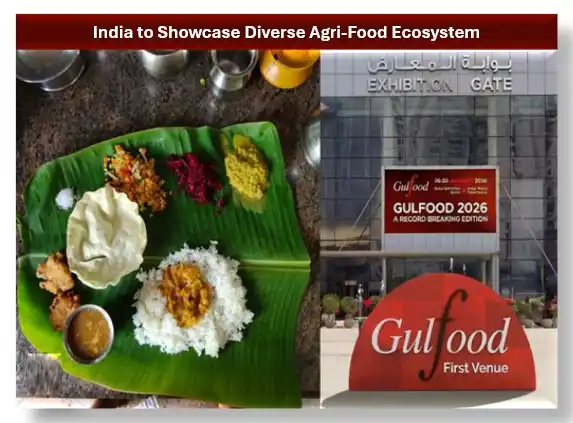
Culinary As Well as Agriculture: The global future is undergoing a seismic shift, with India at the crossroads. The colourful aromas of spices, the taste of top-quality grains and the invention of agritech startups are filling up Dubai World Trade Centre and Dubai Expo City this week. Gulfood 2026 begins today, January 26, and runs for five days as India enjoys unprecedented status as official Partner Country for the first time in the show’s three-decade history.
India has taken initiative to send a large delegation of 161 exhibitors from 25 states, under the aegis of Agricultural and Processed Food Products Export Development Authority (APEDA). It isn’t merely an exhibition, but a statement that India is primed to lead the world’s “Farm to Foreign” supply chain. With 1,434 square meters of doubled exhibition space, the Indian presence at Gulfood 2023 is bigger and better positioned than it has ever been.
The Strategic UAE-India Link: A Global Partner
It is certainly no co-incidence that India has been designated Partner Country for 2026. It’s another aspect of the growing relationship on account of India-UAE Comprehensive Economic Partnership Agreement (CEPA). Bilateral trade in food processing and agriculture has soared ever since its establishment.
For Indian exporters, the UAE is now much more than a destination; it is the “Gateway to Gulf.” With an aim to display its varied agri-food ecosystem to Dubai, India is utilising world-class logistics and re-export facilities offered by the UAE to target markets in the Middle East, Africa and Europe. The pavillion was inaugurated by Shri Avinash Joshi, Secretary, Ministry of Food Processing Industries and Dr. Deepak Mittal Ambassador of India – lending the heavyweight heft of high-level diplomacy to a purely commercial exercise as well.
25 States, One Plate: Dishes That Represent the Best of Each Region
The “States of India” display is one of the more humanised exhibits in India’s pavilion. Instead of a monolithic bloc of “Indian food,” the pavilion dissects the diversity of the subcontinent into regional specialties. From the icy peaks of Jammu and Kashmir to the tropical flats of Kerala, 25 states are showcasing distinct agricultural selfies.
GI-Tagged Treasures and Organic Gems
One of the focal areas this year is Geographically Indicated (GI) products. Here are things that, quite literally, get their life from a place.
The Rice Basket: Over 10 GI-tagged (Geographical Indication) varieties of rice such as fragrant Mushqbudji from Kashmir, black Chak-Hao from Manipur and short-grain Gobindobhog from West Bengal are being served to the visitors.
The Spices Board and the National Turmeric Board The top two bodies, The Spices Board and the National Turmeric Board are showcasing India’s supremacy in world spice trade based on high-curcumin lakadong turmeric and organic ginger.
Millets (Shree Anna): Building on the International Year of Millets, India is promoting a variety of processed millet products — from pasta to snacks — as the “superfood of the future.”
Brought to You by BHARATI Pavilion: Tradition Meets Tech
Although conventional staples continue to drive exports, the BHARATI Pavilion (Bharat’s Hub for Agritech, Resilience, Advancement and Incubation for export enablement) is scripting the future of Indian agriculture.
Chosen from over 100 applicants, eight high-impact startups are demonstrating tech solutions that connect rural farmers to global markets. These startups are presenting:
- Precision Farming Solutions: The application of AI to specifically reduce water and pesticide use.
- Smart Packaging: No-more-chemicals and other innovative methods to keep fresh food fresh longer.
- Blockchain Traceability : The ability for anyone purchasing a bag of lentils in Mumbai or Manhattan to see which Indian farm grew the lentils with complete transparency and trust from around the world.
These startups epitomise the ‘Agri-Entrepreneur’ spirit of contemporary India, underscoring that India is as much a tech hub as it is an agrarian giant.
Gold and Silver Hit Record Highs in India as Prices Surge Sharply
Sensory Diplomacy: The Culinary Zone
Striving to get past the chill of business talks, Indian pavilion showcases exclusive Culinary Area. Celebrity chef Harpal Singh Sokhi is here, demonstrating live on stage and turning Indian raw materials into gourmet global recipes.
The approach may be simple but it works: show, don’t just tell. With the appetite for gourmet foods growing worldwide, international buyers can sample a risotto cooked with Indian GI (geographical indication) rice or a drink spiked with Himalayan herbs to understand the changing face of Indian farm produce. It’s an experiential zone meant to ignite “Culinary Diplomacy”, putting Indian ingredients on the grocery lists of kitchens from London to Tokyo.
Prospect: A Vision of Food Security
At a time when the world is grappling with resilient supply chains and climate change, India’s participation as Partner Country is indicative of her desire to be a “Reliable Sourcing Destination.” The 161 exhibitors are not just making sales; they’re fostering long-term relationships.
India is looking to double its agriculture exports by 2030 and Gulfood 2026 is the launching pad. “From NAFED and the National Cooperative Exports Limited to the tiniest agritech startup, India pavilion is saying with one voice: Bharat is open for business, and you, global buyers of food products, eat at our table,” notes Chafle.
