


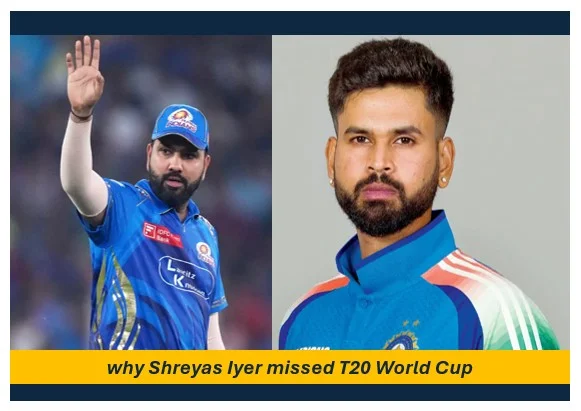
In the high-stakes world of international cricket, there tends to be a vacuum between the announcement of a squad and the opening ball of a tournament. For Indian supporters, the question that keeps arising consistently these past few years is how Shreyas Iyer has missed out on crucial T20 World Cup squads over the years, particularly in 2022.
On Wednesday January 21, 2026, the former Indian captain Rohit Sharma—the man who skippered his country to their T20 World Cup win in 2024—finally did what everyone had been waiting for and explained some of the most difficult decisions he made as a leader. However, the “Hitman” on JioHotstar show ‘Captain Rohit Sharma’s Roadmap for T20 World Cup’ said that it was never about ability but what works for a specific template.
Soak Up Morning Sun During ’Poolside’ Chat On Leadership
The candour from the skipper is a rare in leadership, but Rohit Sharma admitted that he and then head coach Rahul Dravid worked hard on being as forthcoming as they could be. Rohit recalled an emotional scene during India’s tour of the West Indies in 2022 when Shreyas Iyer was taken to a corner by the team and told months before that they would not be part of it.
“Rahul bhai and I have always believed that if you are making such calls, then the guy should know why he is not in this team. I recall we called Shreyas near the pool… we both had a word with him as to why he wasn’t going to be part of that Asia Cup and then the T20 World Cup.
Not as though the reasoning was due to runs not ‘coming’; Iyer had been in good enough nick. Instead, it was about “multi-skills” — a buzzy term that has become the hallmark of contemporary T20 strategy.
Deepak Hooda In Place Of Shreyas Iyer?
Rohit’s analysis came down to a fundamental tactical hole: India had been at the mercy of top-order batters who couldn’t bowl. In a format where one more bowler can win you games, the management had their back against the wall.
The “Sixth Bowler” Snuff away!
Rohit acknowledged in 2022 the top five or six Indian batters were capable of nought with the ball. “We felt that we wanted someone who could give us a little bit more with the ball,” he said. In choosing Deepak Hooda over Iyer, India had given themselves an offspin-bowling option that let the captain fit in one more over at a time when another frontline bowler might have been having an off day.
The Trap of “Only One Spot”
The middle-order reserve spot, one to contest in the straight shootout for a 15-man squad. Rohit mentioned Hooda’s explosive form in the IPL and his ability to bat at any spot in the first six, said that he was the “Swiss Army Knife” that the side required badly at that point of time.
The Form Factor
Hooda at that stage was also fresh from a series of stunning scores, including a T20I century against Ireland. The team management chose instead to go with the “hot hand,” believing that Hooda’s form and bowling would be more useful than Iyer’s reputation of being a steady player.
The Emotional Weight of Selection
Maybe the most humanizing part of Rohit’s admission was admitting to the mental grind that these decisions have on a player. He didn’t shy away from the fact that while one player is overcome with joy, there follows another spraying tears all over his defeated rival.
“If shreyas felt bad, deepak would have been happy — that’s how it goes,” Rohit said in the kind of unadulterated tetchiness only veterans are allowed. “The point is, as long as you have a good reason and they explain it well, that’s all right.”
He also let on that these “tough conversations” were part of his captaincy, citing similar discussions he had with Mohammed Siraj (for the 2025 Champions Trophy) or Yuzvendra Chahal (for the 2023 ODI World Cup). For Rohit, the “open door” policy was necessary in order to keep a good atmosphere in the dressing room even if it meant receiving sad news.
The 2026 Context: Wait, What Just Happened?
Timing of these remarks are important. With India looking to defend their title in the 2026 T20 World Cup — which will be played at home and in Sri Lanka, beginning February 7 — a massive transitional phase is on for the squad. With Rohit, Virat and Ravindra Jadeja all retired from the format, Suryakumar Yadav has taken over as captain.
For once, the T20I conundrum seems to have Shreyas Iyer back in it. He was recently announced as a replacement for Tilak Varma in the series against New Zealand on January 16. “The continued emphasis on leadership and stability is seen as a positive from the performativity perspective,” reads a recent IPL source.
Going Forward: Does Iyer Finally Get In?
With the nucleus of the 2026 World Cup team having been identified for a while now, Iyer’s induction in the New Zealand series is effectively a “late-stage audition.” The average age of the current India T20 team at 25 is younger and more dynamic but they will still attach significance to “togetherness” and “trust,” as Rohit observed, that have been developed over the last two years.
Conclusion: The Legacy of the “Hitman”
Rohit Sharma’s musings are a link between the old and the new. The 2026 World Cup will be the first since the tournament was established in 2007 that he won’t get to see from stadium stands — and it is an experience that makes him feel “strange” and “weird.”
But his comment on Shreyas Iyer solves a perennial mystery for fans! It was not a personal snub or any lack of faith; it was a coldly calculated attempt to prop up an unbalanced team. The morals of “multi-skills” over “specialisation” is still more than a lesson for India, whose best players have come through the ranks with enough wingspans to believe that they should be counted amongst Japan and Spain as multi-sport athletes.
