


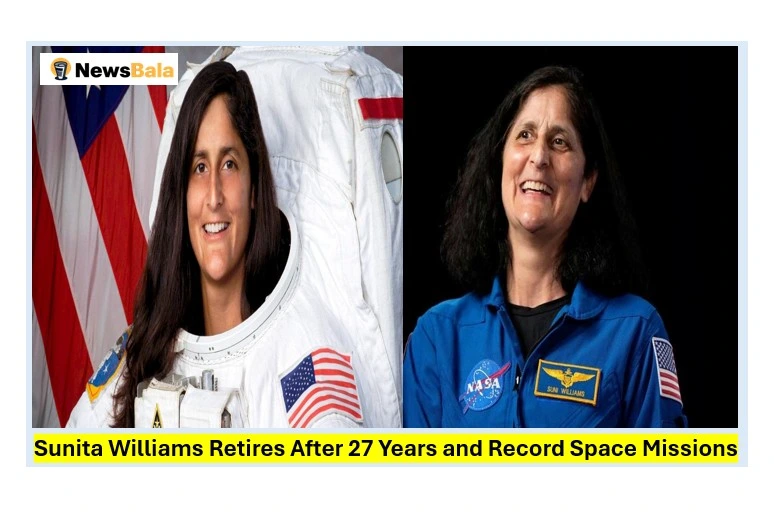
Sunita Williams, an astronaut of Indian descent who was known for breaking new ground at NASA, has left the US space agency after more than 27 years of service. Her retirement at the end of December 2025 marked the end of an amazing age in human spaceflight and discovery, marked by flights that broke records and lasting advances to space science.
The End of an Honorable Career
Williams, who is 60 years old, ended her long and distinguished career with NASA after being a part of many important space projects. It has been confirmed by NASA that she is retiring after a career that lasted almost 30 years and made her one of the most successful pilots in NASA’s history.
Williams spent 608 days in space over the course of three trips. This made her the second longest NASA pilot in terms of total time spent in orbit. She also broke a lot of records. For example, she was the first woman to spend over 62 hours in space, which she did over nine different spacewalks.
Longer and more historic mission
Williams’ long stay on the International Space Station (ISS) was one of the most important parts of her last few years at NASA. In 2024, she and fellow pilot Butch Wilmore took off on a short test journey on Boeing’s Starliner spaceship. But technical problems with the capsule made their mission last much longer than planned.
The journey that was supposed to last only a few days turned into more than nine months and both men will stay on the ISS until March 2025. During this unexpected but important stay, Williams kept working on tests, running the station and science study until she and Wilmore took a SpaceX Crew Dragon ship back to Earth.
NASA officials said that the extended mission showed how resilient and flexible space operations can be. People in the business world said that the ISS crew’s ability to keep working well during the wait showed how well they were trained and how well countries work together.
Achievements and Effects in the Workplace
Williams went into space for the first time on the Space Shuttle Discovery in December 2006. He was a mission expert on the trip and helped build and run the space station. In later years, she was captain of Expedition 33 and other long duration trips on the ISS. Over time, her leadership roles grew to include flight engineering tasks and more complex mission chores that helped shape NASA’s astronaut corps.
Williams worked a lot in space and also had crucial duties in NASA’s astronaut office. Some of these occupations were in charge of training troops and planning their activities. She also worked on particular initiatives, such the NASA Extreme Environments Mission Operations (NEEMO), which teaches people how to study and explore by building underwater houses that are like space.
Williams became a respected figure in the world of space over the course of her career. She was admired for both her technical skill and endurance, as well as her ability to inspire future pilots and space fans.
History and Appreciation
NASA’s administrator and other agency officials have called Williams a pioneer in human spaceflight whose ideas and work have made space travel more successful. People say that her work helped NASA reach its goals in low-Earth orbit and laid the groundwork for future missions, such as current programs to explore the moon and Mars.
Williams’s retirement ends a long career full of hard work, leadership and progress in science. Her life, which was focused on making humanity stronger beyond Earth, is still an inspiration to people who work in space and people who are just interested in space.
Blue Origin Makes History with First Wheelchair User in Space
