


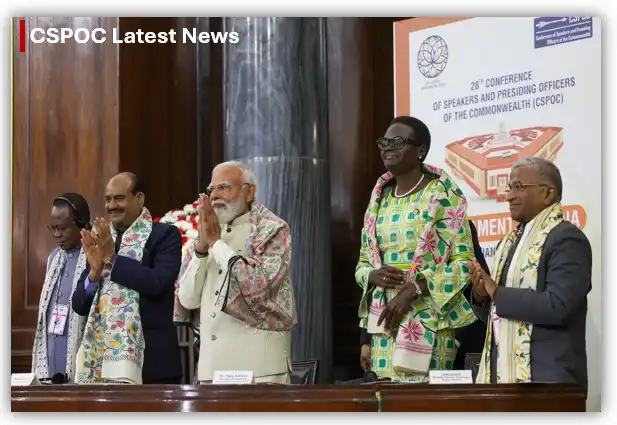
A historic chapter in the annals of the parliamentary history across the world came to a close as sun set along Samvidhan Sadan (Constitution House) today(Friday, Januery 16, 2026). The three-day summit of the 28th Conference of Speakers and Presiding Officers of the Commonwealth (CSPOC) came to an end in New Delhi on January 2, leaving a blueprint for modernising “temples of democracy” spread over 56 nations.
Held in India for the fourth time, this year’s conference was CSPOC’s biggest ever in its 56-year history. It was attended by 61 Speakers and Presiding Officers from 42 countries, and a number of semi-autonomous legislatures. Whether in the high-tech corridors of the UK House of Commons or the up-and-coming parliaments of the Global South, there was a clear message: democracy must update or risk becoming irrelevant in a digital-first world.
The “Digital Scepter” and the Artificial Intelligence: A New Age for Parliaments
The focal point of the 2026 summit was perhaps also its most futuristic: The ethical deployment of Artificial Intelligence (AI) in parliaments. For the first time, the “gatekeepers” of lawmaking wondered aloud about whether AI should get a seat at the table.
Chaired by Lok Sabha Speaker Om Birla, the conference heard and agreed that AI presents “unprecedented opportunities” for efficiency (real-time legislative research and data-driven policy analysis), while also holding a “digital double-edged sword.” Delegates considered how net-zero technologies will be designed and integrated across sectors, the role of AI in misinformation and what ethical lens need to be applied for technology to serve people rather than shape them.
“The test is how to capture the speed of A.I. combined with human empathy and ethical oversight that only a representative of the people can offer,” he added. — Speaker Om Birla
Beyond AI, the effect of social media on the welfare of MPs was another subject that dominated discussion. Numerous Speakers also contributed personal stories detailing the online polarization and how digital “echo chambers” are making consensus to support stable governments difficult to reach.
The Perspective from the “Global South”: PM Modi’s Vision
In his address on 15th January, Prime Minister Narendra Modi cast India as a “Digital Beacon” for the Global South. He extended what one was told has been an unprecedented offer to share India’s open-source tech platforms with fellow members of the Commonwealth, to enable them to develop their own strong digital public infrastructures.
The Prime Minister’s speech signaled a change in the balance of power in the Commonwealth. India’s democracy is based on “last-mile delivery,” he said — the concept that democratic progress can be judged by how well services come to the most marginalized citizens. India hopes to bridge that digital divide by providing technological building blocks to avoid leaving any Commonwealth member nation out of the race.
The environment of the room itself lent gravity to his words. The sessions took place in the Central Hall of Samvidhan Sadan, where India’s Constituent Assembly met 75 years ago to write the country’s founding document.
Passing the Baton: A Glimpse Ahead to Paris 2024 and London 2028
Last day was tabbed by an emotional rite of passage: the handing over of the chairmanship.
Sir Lindsay, who will preside over the 29th CSPOC in London in 2028, lauded Indian hospitality and said the Commonwealth is a “family coming together to protect the democratic world.” The change mirrors the rotating collegiality of the group — a rare international forum that has no binding constitution, but exists through shared values and common parliamentary tradition.
Highlights of the Delhi Declaration 2026Leaders resolve to work for Swaraj; draft constitution aimed at self-governing IndiaThe name Indian National Congress adopted todayResolution on simultaneous electionsParty, not religion, is the real culture: resolutionKey Takeaways from the Delhi Declaration 2026
Though the CSPOC is a voluntary body with no legislative authority over its member nations, its “Delhi Declaration” acts as an influential moral and professional compass. Key commitments included:
Zero-Paper Governance – Following along India’s lead, many parliaments committed to go digital only in an effort to be less wasteful and more environmentally friendly.
Citizen Participation: An emphasis on going beyond “voting-day democracy” to the active participation of citizens through continual digital town halls and interactive portals.
Conclusion: A Legacy of Inclusion
As delegates gear up for a post-conference tour of the pink city of Jaipur, the legacy of the Delhi summit is one of inclusiveness. From India’s winning formula of women-led development in rural local bodies, brought into the spotlight by the Deputy Chairman of the Rajya Sabha, to a very significant emphasis on marginalized voices, 28th CSPOC proved that strength for Commonwealth lies in diversity.
Before the backdrop of these geopolitical developments, the “Guardians of the House” have gone back home with a message. They bring with them what they call the “Delhi Spirit” — an idea that technology, when mixed with tradition and openness, can turn the world’s oldest form of governance into its newest.
