


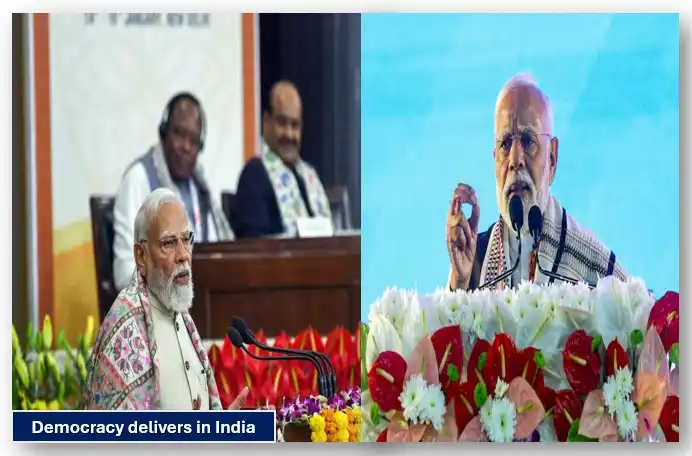
Delhi: In a spirited speech that resonated beyond the walls of the iconic SamvidhanSadan, Prime Minister Narendra Modi opened the 28th Conference of Speakers and Presiding Officers of the Commonwealth (CSPOC) in New Delhi. “Democracy delivers“, said the Prime Minister, building a strong case for the Indian model of governance in one of the largest democracies in the world in his address on January 15, 2026 — with an emphasis on stability, speed and scale.
In front of a global audience of parliamentary leaders, the Prime Minister’s message was straightforward: democracy is not just an academic concept or something that you do every five years when elections are held; it is an engine of high-powered performance for real public good and “last-mile delivery”.
Redefining Democracy as Last-Mile Delivery
Key to the Prime Minister’s speech was last mile delivery. Each of these components can be found in other traditional political theories, but democracy is often conceived primarily to include suffrage (for example, the right to vote). But PM Modi turned the conversation to the result of that vote. The real test of a democracy, he insisted, is not how much it elevates the average citizen but whether or not the least advantaged person has access to its rights and institutions on an equal footing with everyone else.
“Democracy in that sense, for us in India, and we have successfully made it work as a lifeblood of the nation for the last seven decades.” He added that this commitment to public welfare has pulled 250 million people out of poverty recently. Eliminating the obstacles through empowerment constitutes a “democratization of technology” where via government led efforts make sure that benefits reaches people in huge number by directly hitting to them without any intermediary and inefficiencies, which was characteristic addiction of the system.
Despite Doubts: Balance, Speed and Size
Looking back at India’s odyssey since 1947, the Prime Minister referred to the doubts that had once been expressed about the future of India. Early forecasters were skeptical Whether a nation comprising such colossal diversity hundreds of languages, thousands of dialects and widespread geography can survive as a single democracy, let alone as an emerging one.
PM Modi reversed this historical uncertainty. The diversity of India, he said, had in fact become the strength of its democracy. He focused on three pillars in India’s recent growth narrative:
- Stability: Policy environment predictable enough for long-series planning.
- Velocity: The quick build-out of large infrastructure projects and digital networks.
- Scale: The capability to implement programs — like the largest vaccine drive in the world or the UPI digital payment revolution — at a size few other countries’ systems can handle.
In presenting India as the fastest-growing major economy and home to a startup ecosystem that ranks third in the world, Modi showed that democratic institutions were not a blockage of development but its best accelerator.
India: “The Mother of Democracy” and of the Global South
The Prime Minister’s address also went into India’s ancient democratic antecedents, referring to the Vedas and a 10th-century inscription from Tamil Nadu, which detailed village assemblies and provisions for accountability. In dubbing India the “Mother of Democracy,” he wanted to remind the delegates of a Commonwealth summit that the tradition of debate and consensus is “in our blood, in our culture.”
He also cast India as a crucial bridge to the Global South. Home to almost 50% of the Commonwealth’s population, India has used its international fora, most recently through its G20 Presidency, to place the issues that are paramount for developing countries. PM Modi offered India’s “open-source” innovations like its digital public infrastructure to partner countries to facilitate them in building their resilient systems.
The Impact of Technology and the Future
Although the Prime Minister dwelt on the achievements, the conference also discussed new challenges in the digital paradigm. Lok Sabha Speaker Om Birla, who also spoke on the occasion, however advocated careful use of contemporary technologies such as Artificial Intelligence. The conversations at the CSPOC were about how to balance leveraging technology in order to enhance parliamentary efficiency and ensuring that democratic debate is insulated from false information.
In the “Constitution House,” where delegates from 46 countries met, it was the overreaching and staying power of India’s model that remained in focus. The General Elections of 2024, which involved close to 980 million voters, were an affirmation of the monumental logistical and emotional space of Indian democracy.
Conclusion: A Vision for the Future
Democracy Delivers is not only a slogan — it’s the linchpin in how modern nations go about dealing with the challenges of the 21st century. PM Modi’s speech by emphasising the hopes of ‘Janata Janardan’ (common people to God) hinted that democracy is an effective instrument in transforming diversity into a national power.
And amid the continuing evolution of the Commonwealth, India’s experience serves as an example of how ancient values and modern technology can be combined to form a system of governance that is not only inclusive but also eminently efficient.
