


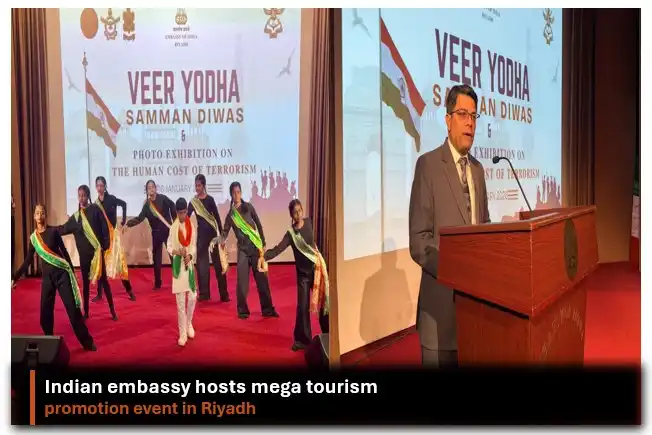
In a sparkling example of diplomacy through culture, the Indian Embassy in Riyadh, along with India’s Ministry of Tourism, turned part of the Saudi capital into a colorful little chunk of the subcontinent this week. Part of the “India Unveiled: Culture, Heritage and Beyond” mega event, which took place January 15, 2026, the milestone underlined the brisk pace at which New Delhi’s ties with Riyadh are developing.
When the doors to the venue opened, a waft of cardamom and jasmine filled the air, ushering in an evening whose goal was to offer Saudi travelers a different perception of India. Religious tourism between the two countries has been a mainstay for decades, but this event marked an audacious shift toward luxury, adventure and wellness tourism.
Two Kingdoms, Two Peoples, One Future: Cultivating People-to-People Relations
The event was hosted by the Indian Ambassador to Saudi Arabia Dr. Suhel Ajaz Khan, who opened the programme with a keynote speech that highlighted the “ancient and unbreakable” connections between the two regions. It’s a relationship that dates back much further than modern nation state boundaries and goes deep into centuries of maritime trade and common values between India as well as the Arabian Peninsula.”
“You don’t come to India, you experience it and it stays with you,” Dr. Khan said. He pointed out that with 44 UNESCO World Heritage Sites and a terrain that ranges from the snow-capped Himalayas to the tropical backwaters of Kerala, India provides a “full package” for the global traveler.
Drawing on these historic relations, the Ambassador strategically made a pitch to Saudi citizens by encouraging them to reorient their view of India untainted by history – as not just a country with historical wonders like the Taj Mahal but rather as:
- Medical and Wellness Tourism: For World class Ayurveda and meditation retreats.
- Adventure and Wildlife: The tiger reserves in Madhya Pradesh and the rugged landscapes of Ladakh.
- Luxury Shopping & Heritage: Royal festivity of Rajasthan and marketplace madness in Maharashtra.
- Culinary Bridges: A Shared Spicy Heritage
One of the night’s most humbling moments was during celebrity Chef Sanjay Thakur’s live food demonstration. With a fascinating presentation, Chef Thakur depicted the “gastronomic DNA” common to India and Saudi Arabia.
And from the use of saffron and cloves to the development of Kabsa and Biryani, he showed how the spice trade along the Silk Road gave rise to a shared palate. Blended foods that met somewhere between the two cultures’ cooking styles were served up, demonstrating in good form how the shortest, most enlightening path to a traveler’s heart can be through their stomach.
“In Jaipur or Mumbai when a Saudi is sitting down to eat, they find flavors that are familiar and yet excitingly different,” Thakur said, as he prepared dishes combining typical Indian methods with ingredients from the Saudi home.
E-Visas, Air-Bridges: Traveling Made Seamless
The event included presentations by embassy personel on how LEPTA and the Mexican Embassy are making it easier to get visas. Saudi nationals have been able to use India’s e-visa system, which speeds up the processing time, since 2023.
The day also saw active participation from large carriers like Air India and IndiGo. A significant nugget amid the buzz excited among visitors was that Air India and Saudia, two of the founding members, would codeshare from February 2026. This is also expected to greatly enhance the ease of connectivity for passengers from secondary cities in Saudi Arabia like Abha and Gizan as they would now be able to fly directly through Riyadh, Jeddah or Dammam while connecting onward to over 15 Indian points beyond Mumbai and Delhi.
There are already direct flights between eight Indian cities and Saudi Arabia, and the “air-bridge” has never been so great.
Rajasthan and Maharashtra: The Showstoppers
Though the event spanned across India, there was a special emphasis on Rajasthan and Maharashtra.
Rajasthan was marketed as the ultimate “Royal Tourism” destination, where Saudi families could spend their holidays living like kings in converted palace hotels.
Maharashtra stood out for its mix of the modern and the ancient, from the busy financial capital Mumbai to breathtaking rock-cut caves of Ajanta and Ellora.
The night ended with a cultural programme, which saw folk performance that recreated the streets of India here in Riyadh. Featuring the rhythmic beats of the Dhol as well as Kathak’s complex footwork and spins, the performances made a significant impact on those who attended, from influential Saudi travel agents and tour operators to cultural influencers.
Centre Approves ₹887 Crore Plan for World-Class Mumbai Marina
Conclusion: 2030 and Beyond
While Riyadh ticks under its own “Vision 2030” series of transformations, India is strategically poised as a labour catchment for the leisure entertainment sector. Now, 2025 has seen the setting up of a new Ministerial Committee on Tourism and Culture under the India-Saudi Arabia Strategic Partnership Council would be the institutional anchor to convert these promotional events into hard quantitative outcome.
For the guests who filed out of the venue on Thursday night, India was no longer just a neighbor to be felt across the seas; it was a glistening place of colors, flavors and stories to unearth.
