


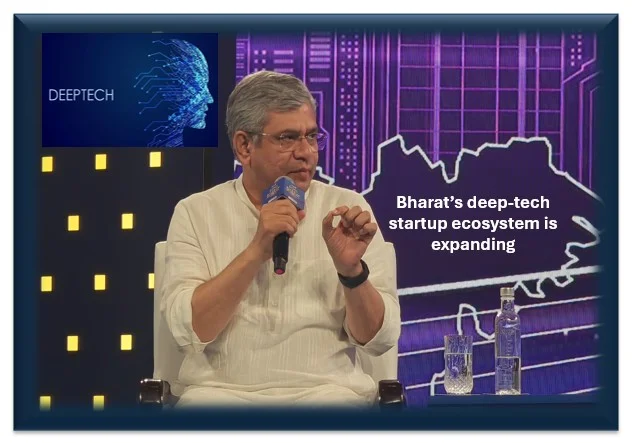
No more just a service provider in the fast-paced global tech space, India is gaining the label of “product nation“ as well. It was January 16, 2026, National Startup Day, and Union Minister for Electronics and IT Ashwini Vaishnaw had a strong message about the country’s entrepreneurial scene. His core takeaway? India’s deep-tech startup ecosystem isn’t just growing; it is witnessing a structural expansion resulting from high-end innovations and policy support from the government.
The move from traditional software services to deep technology — semiconductors, quantum computing and advanced artificial intelligence are all part of the mix — represents a crucial moment in India’s quest to be a $7 trillion economy. The days of “copy-paste” business models are being replaced by a generation of founders who are solving very hard, never-solved-before problems with technology they are inventing for the first time.
From Code to Chips: A Sneak Peek Inside China’s Semiconductor Push
When you take a look at some of the statistics mentioned by Minister Vaishnaw, one thing truly comes across: as of today, 80% of India’s Startups are AI-led! This isn’t just the simple chatbots; it regards startups integrating AI into at the very heart of their business; from Predictive Healthcare and Precision Agriculture to Advanced Industrial Automation.
One of the major factors leading to this change was the Design Linked Incentive (DLI) programme under India Semiconductor Mission. The program has already approved 23 startups for chip design and semiconductor development, the Minister added. As a country that’s long been one of the world’s hardware importers, this homegrown push toward silicon sovereignty has potential to change the game.
$1 Billion Shot in the Arm: Building a Financial Spine
Deep-tech ventures are known to be notoriously capital-intensive, and in need of “patient capital” – investors who understand that it takes years, not months, to develop a new medical device or quantum processor. To grapple with this, the government has gone beyond standard grants to develop a solid institutional funding model.
Minister has pointed out the following key financial “pillars:
- India Deep Tech Alliance (IDTA): Unveiled at the Semicon India 2025, this $1-billion alliance has been conceptualized to offer ‘firepower’ for startups to scale their research into marketable enterprise solutions.
- RDI Fund: The ₹ 1,00,000 cr RDI Fund is a definitive indicator of Govt’s long term vision. This corpus particularly targets the reinforcement of innovation capacities and facilitating researchers in crossing the “valley of death” between a laboratory prototype and an unglamorous product ready to be placed on the market.
- Startup India @10: Dove-tailing into the 10th year of Startup India in 2026, the new focus is on quality. With more than 2,00,000 registered start-ups in the country, the focus is on developing global leaders in strategic areas such as green hydrogen and space-tech.
- Democratization of Innovation: The Emergence of Tier-2, Tier-3 Cities
Geographically, there’s one really humanizing thing about this growth. The deep-tech boom now extends beyond the glass towers of Bengaluru or Gurgaon. Both Minister Vaishnaw and Prime Minister Narendra Modi emphasized that the “Rainbow Vision” of startup ecosystem is reaching to the grassroots.
Today, almost 50% of the identified startups in India come from Tier-II and Tier-III cities. Whether in a biotech outfit in Indore or a robotics lab in Coimbatore, the democratization of technology is helping local talent solve local problems to meet global benchmarks. And the ecosystem is also getting more inclusive – with over 45% of startups having at least one woman director or partner, India becomes the second largest ecosystem in terms of women-led startup funding.
The Road to 2047: Building a “Viksit Bharat”
With India’s sights set on 2026 and beyond, the challenges are clear: to continue sourcing investment in a world of uncertainty, and to forge a smooth path for engineering talent. But the Minister is still supremely confident. Through such integration of startups in national missions — like the IndiaAI Mission, which has onboarded more than 38k GPUs to bring down costs of computing — it is making certain that the barriers to entry with deep-tech don’t become prohibitive.
The shift is palpable. And founders are wasting less time on “vanity metrics” and more on the patents. They are creating hardware that withstands the heat and dust of rural India, as well as software that supports 22 official languages. In Ashwini Vaishnaw’s world, the deep-tech expansion is not just an economic number; it is the sine qua non of a self-reliant, high-technology Bharat.
