


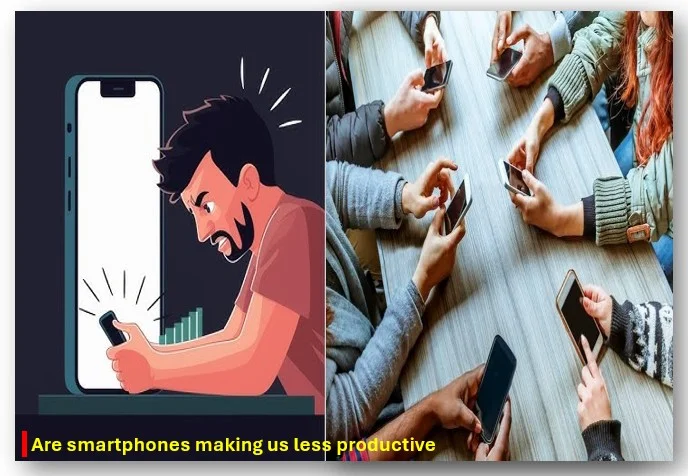
The Illusion of Multitasking
Smart phones foster rapid task-switching: checking e-mails, texts, social media, or the news, often in the name of productivity. However, the insights of cognitive science are that multitasking is basically a delusion. Rather, we task-switch rapidly, impairing each task in the process, often without actually accomplishing much in cognitively demanding work.
Work Creep & Burnout
Always-On connectivity clouds the distinction between work and rest. Smartphones enable work to easily enter evenings, weekends, and vacation time. Being responsive can be helpful, but being constantly available is stressful and undermines rejuvenating time. Productivity diminishes if rest is undermined. Burnout is not a measure of productivity; it illustrates a lack of balance.
Read more:
- Rise of “AI coworkers”
- Grok AI misuse sparks global concern targeting women
- How AI can change our daily lifestyle?
The Case for Greater Power
- Unprecedented Access to Information
Smartphones allow us access to the entire library, navigation with GPS, translation, and current data with only one’s fingers. Rather than taking hours to accomplish tasks, such as getting directions, doing research, or organizing logistics, one can do it all in under minutes.
The effect of having all of these available in one’s palm, especially to students, professionals, and entrepreneurs, means that it is possible to accomplish more in less time.
- New Forms of Coordination and Creativity
Messaging, collaborative document editing, project management on smartphones,, empower small groups to function in ways akin to those of large entities. These enable the production, editing, distribution, and dissemination of content without much production cost, thus ensuring the distribution of content that would not have been accessible otherwise.
- Personal Productivity and Accessibility
If used in a deliberate way, a smartphone can be a potent tool for productivity. Calendars, task management applications, reminders, habit-tracking applications, and note-taking applications help people externalize their memories and organize their time. For people living with disabilities, smartphones provide accessibility applications like voice assistants and screen-readers.
- Design Matters: Attention as a Commodity
One of the main contradictions is at the level of business models: smartphones and apps. Most platforms are based on monetizing attention; that leads to a design that’s maximally about time on device, not value created. Infinite scroll is not a neutral feature; algorithmic feeds are not neutral features; variable rewards are not neutral features-they shape behavior. When tools are irresistible, self-control becomes an unfair expectation.
But design can also work in the other direction. Features like focus modes, notification batching, usage dashboards, and grayscale displays show that technology can support intentional use. The same device that distracts can also protect attention-if incentives align.
- The User’s Role: From Consumption to Intentionality
Smartphones amplify intention. Passively deployed, they drain time and energy; used intentionally, they extend capability. The difference too often comes down to habits: disabling non-essential notifications, defining phone-free blocks for deep work, choosing creation over consumption. Using the smartphone as a tool rather than as a default companion makes a difference in the relationship.
The important thing, however, is that productivity is not only about producing, it has to do with outcomes. So, if your smartphone enhances your ability to learn faster, work together with other people, or manage responsibilities, it means you are increasing your productivity, even though it has the capacity to allow you to relax.
Conclusion
Are smartphones making us less productive or more powerful? The truth lies somewhere in between. They are capable of fragmenting our attention, promoting shallow work, but they are also incredible for increasing access, coordination, and creativity. Smartphones are simply amplifiers: they simply increase the effect of our intentions.
The coming years are not a question of rejecting smartphones, but of shaping them, through good design, positive norms, and wise usage, to allow the benefits to trump the distractions. Getting things done in the smartphone era means less resistancing and more mastering of the technologies available to you.
