


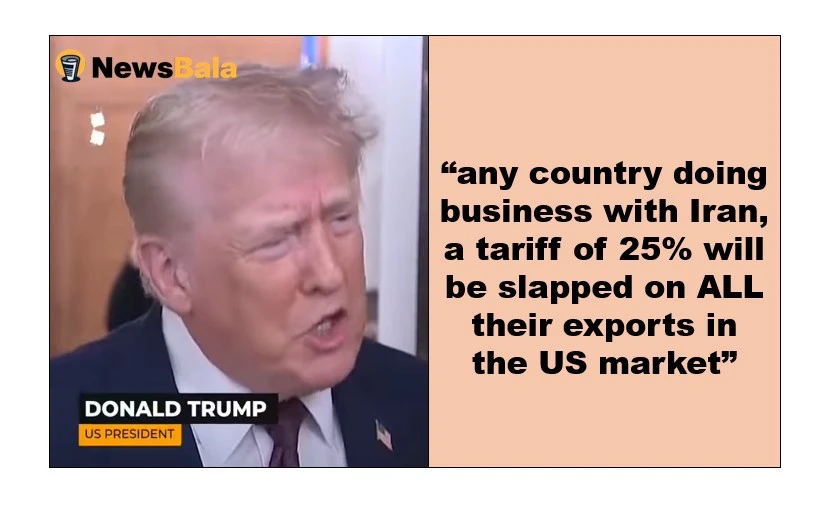
Shaking world financial markets, U.S. President Donald Trump said today he would slap a 5 per cent tariff on all Mexican imports to pressure the country to do more to crack down on drug traffickers and illegal migration into the United States. On Monday, January 12, 2026, the President announced that if any country is still doing business with Iran then a tariff of 25% will be slapped on ALL their exports in the US market.
The announcement, which Mr. Trump posted on his social media platform and was then followed quickly by White House press briefing, amounted to a major escalation of Washington’s “maximum pressure” campaign against the Iranians. The United States, by harnessing its perch as the world’s biggest consumer market, is in effect issuing a global ultimatum: Continue trade with Tehran or preserve access to the American economy.
A “Final and Conclusive” Decree
The president’s communication was typically blunt: “Final and conclusive is this order.” Unlike most trade measures that take months of diplomatic wrangling and phase-in, this one was enacted with immediate effect.
“Anyone doing business with Iran will NOT be doing business with the United States,” the President wrote on Twitter.
The timing of this order will be no accident. All of this at a time when Iran is convulsed by its biggest wave of anti-government protests in years. Rights groups say nearly 650 people have been killed in a deadly state-led crackdown on protestors. By going after Iran’s international sources of revenue, the U.S. government seeks to deprive the regime of the financial lifeblood it is using to support its security services.
The Worldwide Fallout: Major Economies Hit From All Sides
The 25 percent tariff is not a surgical strike but instead a broad-spectrum economic weapon that looms over some of the United States’ most important trading relationships. A number of the world’s leading economies today have substantial trade with Iran, making them direct targets of any blowback:
- China: As Iran’s biggest trading partner and a top buyer of Iranian oil, China could lose billions if the U.S. were to place a 25% surcharge on its huge exports to America.
- India: New Delhi has a complicated but crucial relationship with Tehran, especially when it comes to energy imports and strategic investment in the Chabahar Port.
- The United Arab Emirates and Turkey: These middlemen of the region are Iran’s two main arteries for trade and finance, and both now face the potential of serious friction with Washington.
- The European Union: Although the EU has tried in the past to uphold the JCPOA, at present its companies have a stark choice between their Iran investments and access to America’s huge markets.
Some economists caution a step of that nature could provoke a “meaningful shock” to the global supply chain. If carried out without exceptions, American consumers may see prices increases on anything from electronics and machinery to textiles and compatible automotive parts from these “secondary” trading partners.
Trump says US military considering ‘very strong options’ for Iran
Diplomacy vs The “Lethal Option”
And while the tariffs are a potentially devastating economic blow, there is ample indication from the White House that this is only one piece of a multi-tiered strategy. Press Secretary Karoline Leavitt on Monday confirmed that while “diplomacy is always the first option,” if violence against Iranian protesters did not stop, the President is considering “very strong options,” which includes possible airstrikes.
The administration’s position is that the Iranian government has crossed “red lines” by employing lethal force against its own people. The U.S. is trying to goad the rest of world into a “cordon sanitaire” around Iran, hoping that all or most other countries collectively would boycott it or face reduced trade with America.
Legal and Market Uncertainties
Despite the President’s post being a “final” one, there are still massive legal obstacles in the way. Analysts say the administration could be counting on a law known as the International Emergency Economic Powers Act (IEEPA) of 1977, that has been widely used in the past year to impose different trade actions. The individual tariffs are certain to be immediately challenged in U.S. courts, though, amid the backdrop of a Supreme Court looking at the broader legality of executive branch actions on trade.
Additionally, with no formal White House policy document or accompanying granular implementation guidance available, businesses have been left in a kind of limbo. And everything from goods currently en route, including on ships weeks away from American ports, to the items that theoretically could leave China’s factories tomorrow and would carry a 25 percent tax upon arrival could become a nightmare for importers and logistics companies.
Conclusion: A High-Stakes Gamble
The 2026 Iran tariff decree is a high-stakes bet and an attempt to see how far American economic dominance can push. By weaponizing trade in the name of human rights and geopolitical goals, the United States is effectively redrawing lines for global trade.
The question of the year remains whether this step brings the Iranian regime to the bargaining table, or simply cements American allies and adversaries even closer in opposition to Washington. As the world watches the dust settle, one thing is certain: The price to pay for doing business with Iran just got out of hand.
