


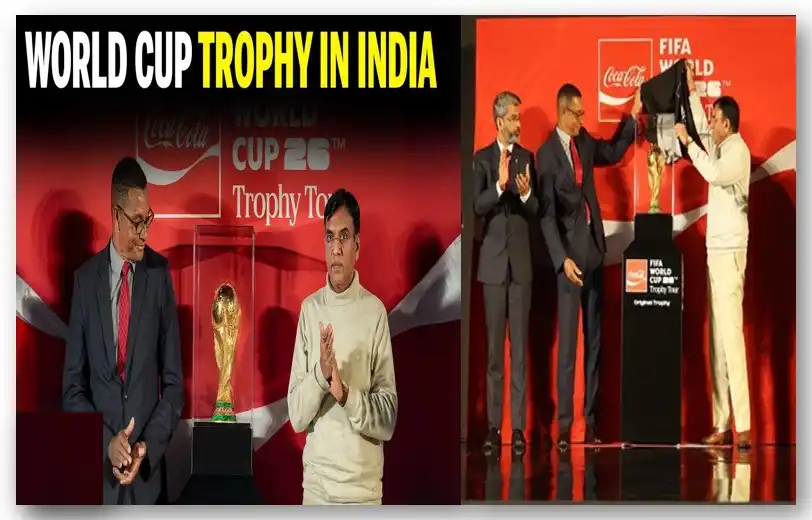
In a meet that served as a meeting point between a Nation captivated by cricket and the future of world sport, the original FIFA World Cup 2026 Trophy touched down in New Delhi on Saturday, January 10, 2026. The arrival is historic as after 12 year years country has seen the iconic Solid 18-carat gold trophy touch base in India and the tour across th nation would be setting the tone for football fever in India.
The national capital was the venue of a grand unveiling that launched a three-day high-powered roadshow. The image of the same silverware hoisted by legends such as Pelé, Maradona and Messi was for far more than taking a photograph with: it was a sobering reminder that the global football dream is inching closer to home.
A Golden WelcomeThe Unveiling in New Delhi
It was an electrifying atmosphere at the unveiling. The trophy was unveiled by Union Minister for Youth Affairs and Sports, Dr. Mansukh Mandaviya along with FIFA Legend Gilberto Silva – Brazil’s 2002 World Cup winner. The former Brazilian midfielder, who had an “Invincible” season with Arsenal expressed that he was really shocked to see the intensity of love India has for football.
“We always hear that cricket is king in India,” Gilberto said at the ceremony. “But now I’m here and see this enthusiasm, I understand that football is loved as well. My dream is that this trophy serves as inspiration for the next generation of Indian boys and girls to believe that they can compete for this trophy too.
Sports Minister Mandaviya expressed the same feelings saying the trophy tour is associated with government’s vision Viksit Bharat 2047. He stressed that with programmes like Khelo India and FitIndia, the county is preparing to be in the top 10 of sports powerhouses by 2036. The trophy’s arrival is believed to act as a psychological booster for 100 million football-inspired fans in India.
Introducing the Itinerary: The Road from the Capital to the Gateway of the Northeast
The prize’s time in India is short but strategically timed to generate engagement:
- Jan. 10-11 (New Delhi): The trophy spends two days in the capital city, with thousands of enrolled fans as well as budding footballers from neighbourhood academies getting an opportunity to see it from close quarters.
- January 12 (Guwahati): The trophy makes its way to Assam on the last day of the tour. Picking Guwahati as the next stop is an acknowledgment of the Northeast’s place as Indian football’s “powerhouse,” where football often equals or eclipses cricket in resonance.
The tour is part of the FIFA World Cup Trophy Tour by Coca-Cola, which will travel to 30 countries at 75 stops before the start of the tournament in June. The 2026 tournament, co-hosted by the USA with Canada and Mexico, will be the biggest yet as it is expanded to include 48 teams.
Life Beyond the Glitter: A Symbol of Aspiration
The trophy’s arrival has been a part in President Kalyan Chaubey and AIFF’s long-term plan, ‘Vision 2047’. As India strives to reach its first World Cup, Chaubey added that “seeing the trophy is making the dream come true and also seems reachable.”
The trophy specs were technical in an awe-inspiring sort of way. The design – two human figures supporting a world in their hands — has not changed since it was made from solid 18-carat gold and weighs 6.175 kg (9 lb, 3 oz) back in 1974. It is perhaps the most famous sports trophy anywhere in the world, and it being brought to India underlines FIFA’s increasing awareness of the Indian market as an important battleground for football against other sports.
Background to the ‘Grok’ and ‘Deepfake’ Controversy
Curiously, the trophy tour should come at a time when digital well-being and ethics are on everyone’s lips in India (following X’s recent controversial “obscene image” row). Athletics officials are using the high profile event to push for “healthy and positive digital engagement” among young people, who should be turning to social media to share about their sporting achievements as opposed to sharing dangerous content.
As the trophy gets ready to travel to its next global stop after Guwahati, the message it leaves behind is that India may be a cricket nation right now – but with every visit of the golden statuette, seeds for a footballing tomorrow are being sown.
